

Intro GAPS and Full GAPS are two phases of the same nutritional protocol. Intro moves through six stages and adds foods and cooking methods gradually. Full GAPS starts with a wider range of meals but keeps the same foundation of homemade stock, soups, fermented foods, animal foods, fats, and suitable vegetables.[1][2]
Our family chose Intro, followed it closely, and moved slowly. Much of our pace was guided by the child with eczema. The first six weeks were hard, and people in the same household experienced those weeks differently. The day before we started, we made one large Stage 1 shopping trip and cleared out the foods that did not fit. That is our experience, not a calendar for another family. The longer account is in Our GAPS Journey.
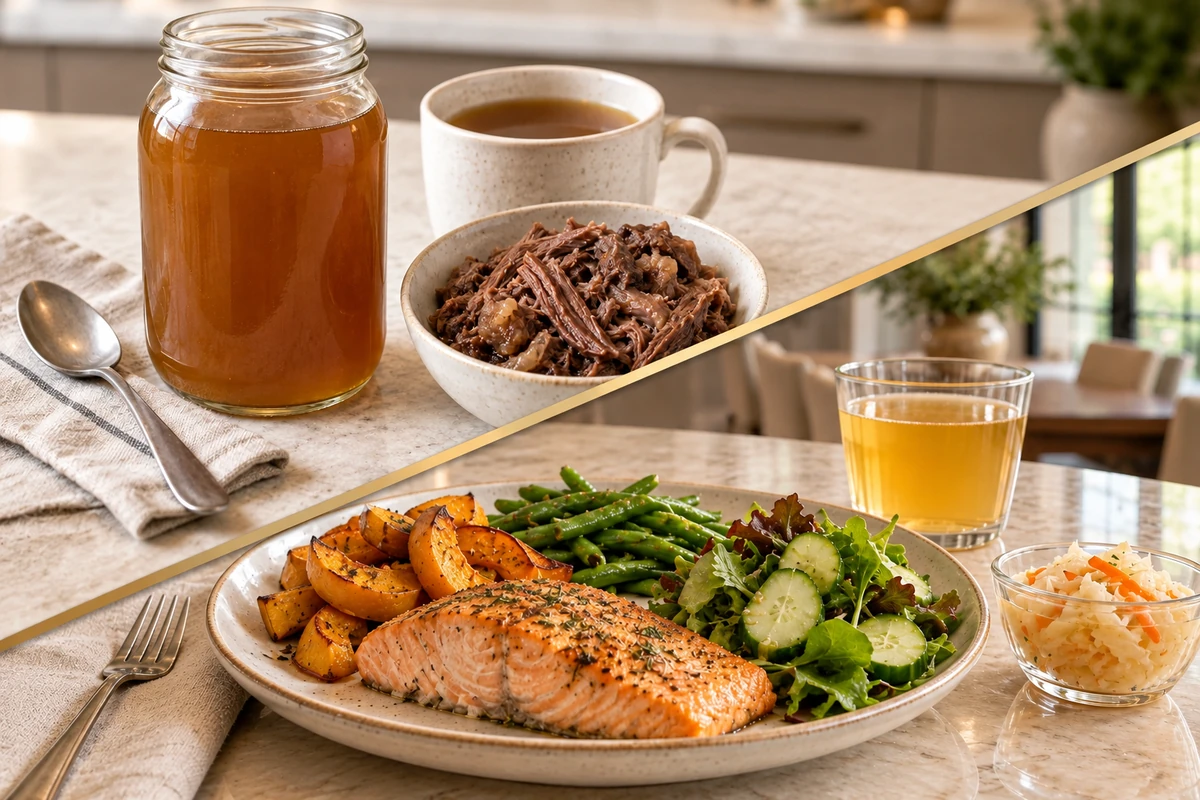
What Stays the Same
Both phases use homemade food and keep grains, refined sugar, processed food, and the other standard GAPS exclusions out. Meat stock, soups, fermented foods, animal foods, natural fats, and allowed vegetables remain central.[2][3] Moving from Intro to Full GAPS widens the menu. It does not mean coming off GAPS.
- Earlier Intro foods stay in. Each stage continues the foods that came before it.[1]
- Full GAPS is still structured. Ingredient choice, preparation, and tolerance still matter.
- Standard GAPS is not automatically ketogenic. Ketogenic GAPS is a separate named approach with a different food balance and sequence.[4]
Intro GAPS vs. Full GAPS at a Glance
| Detail | Intro GAPS | Full GAPS |
|---|---|---|
| Structure | Six cumulative stages[1] | Broad allowed-food list without numbered stages[2] |
| Early meals | Meat or fish stock, soup, boiled meat or fish, and well-cooked allowed vegetables[1] | Eggs, roasts, fish, salads, cooked vegetables, soups, and ferments[3] |
| Preparation | Methods expand by stage[1] | More methods are available from the beginning[3] |
| Raw produce | Introduced later in the stages[1] | Allowed within the Full GAPS list and individual tolerance[3] |
| Nuts and seeds | Nut butter begins in Stage 3 and nut-flour baking in Stage 4, using properly prepared nuts or seeds[1][2] | Properly prepared nuts, seeds, and their flours are used in moderation[2][3] |
| Duration | Individual and based on tolerance and stool changes[1] | For the majority, the strict GAPS Diet is followed for at least two years, and non-GAPS foods wait until digestion has been normal for at least six months[2] |
For guidance on where to begin, see Who Does GAPS Direct to Full GAPS First?
Keep the comparison beside your meal plan. Get the Intro and Full GAPS Food List for a stage-by-stage reference while you shop and cook.
How the Plate Changes Through Intro
Stage 1 is the narrowest part of Intro: homemade meat or fish stock, soup, boiled meat or fish, well-cooked allowed vegetables, and probiotic food introduced gradually. Stage 2 adds raw organic egg yolks separated from the whites, stews, casseroles, fermented fish, and ghee. Stage 3 adds avocado, the GAPS pancake, eggs cooked in animal fat, and fermented vegetable solids. Stage 4 adds roasted or grilled meat, olive oil, freshly pressed juice, and nut-flour bread. Stage 5 adds cooked apple and then raw vegetables. Stage 6 adds raw fruit, more honey, and allowed sweet baking.[1]
The short version matters here: Intro changes both the ingredient and the preparation method. A food appearing in a later stage does not move it into an earlier one. Use the complete Intro stage guide and the GAPS food list for the exact stage details.
What Widens on Full GAPS
Full GAPS makes ordinary meal planning more flexible. A roast can become tomorrow’s lunch. Eggs and vegetables can be breakfast. Fish, salad, and soup can all appear in the same week. Official guidance says about 85 percent of daily food should come from meats, including organ meats, fish, stock, eggs, fermented dairy when tolerated, and vegetables that are cooked, raw, or fermented. Fruit and baked goods made from allowed nut or seed flours are kept in a smaller role.[3] If you start directly with Full GAPS, leave fruit and baking out for the first few weeks, then introduce them slowly while watching for returning symptoms.[2]
See how to build Full GAPS meals for the broader phase in practice.
Dairy Is Introduced Differently
Dairy is not one single category in GAPS. Ghee, butter, yogurt, kefir, sour cream, and cheese are different preparations. Intro introduces suitable dairy gradually within the stages when it is tolerated. People who skip Intro and begin with Full GAPS are directed to the separate GAPS Dairy Introduction structure.[3][5]
The Intro quick facts also say people with eczema, acne, dermatitis, or psoriasis may want to remove all dairy temporarily, including homemade dairy.[5]
What a Day of Meals Can Look Like
| Meal | Early Intro | Later Intro | Full GAPS |
|---|---|---|---|
| Breakfast | Stage 1: Chicken and vegetable soup made with meat stock[1] | Stage 2: Soup with raw organic egg yolk separated from the white; soft-boiled eggs after yolks are tolerated. Stage 3: Gently fried or scrambled eggs, or GAPS pancakes[1] | Eggs and vegetables, cultured dairy when tolerated, or leftovers[3] |
| Lunch | Stage 1: Soup with boiled meat and vegetables[1] | Stage 2: Stage-appropriate stew or casserole. Stage 1 onward: Soup with foods already introduced[1] | Soup, leftover roast, fish, or salad with an allowed protein[3] |
| Dinner | Stage 1: Stock, boiled meat or fish, and cooked vegetables[1] | Stage 4: Roasted meat, with foods already introduced[1] | Roast, fish, eggs, vegetables, ferments, or a hearty soup[3] |
“Later Intro” covers several stages, so put the stage number beside every recipe on an Intro meal plan. That prevents a Stage 5 ingredient from slipping into a Stage 3 week because the recipe itself looked familiar.
How Long Each Phase Takes
Intro does not follow a fixed calendar. The protocol says to move faster or slower according to stool changes, digestive symptoms, and tolerance, and to delay a new food when symptoms return.[1] Our six difficult weeks cannot be used as someone else’s schedule.
In the “Coming off the GAPS Diet” section of her 2020 book, Gut and Physiology Syndrome, Dr. Natasha Campbell-McBride says that, for the majority, the strict GAPS Diet should be followed for at least two years. Non-GAPS foods are introduced only after digestion has remained normal for at least six months. Coming off GAPS is a separate, gradual process, and the source says not to rush it.[2]
Who Does GAPS Direct to Full GAPS First?
Pregnancy
Official GAPS material generally directs pregnant mothers to Full GAPS.[4][5]
It preserves a specific pregnancy exception: for colitis with severe diarrhea, vomiting, and abdominal pain during pregnancy, the official FAQ directs the mother to begin Intro at Stage 2 with plenty of animal fats and liver, and homemade kefir introduced gradually from the beginning.[6]
The pregnancy FAQ also gives dairy instructions based on the dairy foods eaten before pregnancy. That pregnancy-specific guidance belongs beside the starting-route decision, rather than assuming the ordinary Full GAPS dairy sequence covers every pregnancy.[6]
Nursing
Official GAPS material generally directs nursing mothers to Full GAPS.[4][5] The official FAQ allows Intro once the baby is eating solids and breast milk is used only for topping up.[6]
A separate breastfeeding FAQ answers a mother nursing a 22-month-old who was reacting to foods. It describes Intro Stages 2–3 for that mother while her child moves toward a full diet and breast milk becomes a supplement. Keep that older-child case separate from the general newborn nursing route.[6]
Constipation
The Intro quick facts do not recommend Intro for people with severe constipation. The broader diet overview also points to Full GAPS first for chronic constipation.[4][5]
The book’s chronic-constipation discussion specifically describes people relying on fiber to pass stool. It directs them to start with Full GAPS and resolve that constipation before attempting Intro, where fiber is reduced.[2]
Fat Digestion and Histamine Issues
Dr. Campbell-McBride’s 2020 book recommends a slow, individualized Intro for histamine sensitivity. Very sensitive people may begin without fermented foods, then try tiny amounts.[2] If fat is difficult to digest, her FAQs recommend starting with small amounts at meals and increasing gradually; that is a separate question from choosing Intro or Full GAPS.[6]
Travel, Work and Kitchen Constraints
The broader diet overview points to Full GAPS when travel, work, limited cooking access, or compliance makes Intro a poor first fit.[4]
For travel or work without a place to cook, her 2020 book suggests returning to the Intro question in about six months to a year, once the kitchen work is practical. For a teenager who cannot sustain Intro yet, it describes about a year on Full GAPS and encourages taking part in cooking. These are different starting situations, rather than one waiting period for everyone.[2]
No Serious Digestive Symptoms
The broader diet overview also points to Full GAPS as a starting option for people without serious digestive symptoms.[4]
Campbell-McBride also describes a small group in her practice, including people with depression, ADHD or autoimmune disease, who followed Full GAPS without later Intro. She still recommends Intro at some point for the majority, sometimes more than once.[2]
Related Guides
- What Is the GAPS Diet?
- GAPS Diet Food List
- The GAPS Intro Stages Explained
- Full GAPS Meals
- Our GAPS Journey
Intro and Full GAPS FAQ
Do You Have to Complete Intro Before Full GAPS?
No. Full GAPS is a valid starting phase. GAPS also identifies circumstances in which someone may start with Full GAPS and consider Intro later.[4]
Is Full GAPS the Same as Being Off GAPS?
No. Full GAPS still follows the allowed and excluded food lists. Coming off GAPS is a later transition with its own progression.[3][4]
Can You Eat Carbohydrates on Intro or Full GAPS?
Yes. Allowed vegetables and fruits contain carbohydrates. Standard GAPS and Ketogenic GAPS are separate approaches.[4]
Your Next Step
Start with my chicken meat stock and Intro soup steps for Stage 1 and my Full GAPS slow-cooker pot roast with turnips and carrots for a Full GAPS meal. Both pages include ingredients, instructions, and storage guidance.
With those recipes beside you, write one day of meals for Intro Stage 1 and one day for Full GAPS using foods you can obtain and cook. Compare the preparation, storage, and help each day requires. Then read the detailed guide for the phase you are considering.
References
- Campbell-McBride, N. “GAPS Introduction Diet.” Stages 1–6 and progression guidance.
- Campbell-McBride, N. Gut and Physiology Syndrome (2020), “GAPS Introduction Diet,” “The Full GAPS Diet,” “Coming off the GAPS Diet,” and “Histamine and Other Biogenic Amines,” slow individualized Intro and the initial no-fermented-food exception.
- GAPS Diet. “Full GAPS Diet: Recommended Food List and Foods to Avoid List.”
- Campbell-McBride, N. “The Full Spectrum of the GAPS Diet.”
- GAPS Diet. “GAPS Introduction Diet.” Quick facts and food chart.
- Campbell-McBride, N. “Frequently Asked Questions.” Official GAPS materials, “Baby,” question 2; “Pregnancy,” questions 1 and 12; and “Breastfeeding,” question 3; and “Gallbladder,” questions 2–3, gradual fat introduction.

35 responses to “Intro GAPS vs. Full GAPS: What Changes on Your Plate”
[…] and the food guide for demyelinating disease covers the chapter’s food discussion. Use the Intro-versus-Full comparison if you need to understand the difference between those starting points. Eda’s two-week […]
[…] the practical choice between Intro and Full GAPS, I have a comparison of what changes on the plate. Use that alongside the book when you are trying to picture the cooking involved. The book provides […]
[…] Intro and Full GAPS have different menus, and some people begin directly with Full GAPS. The Intro versus Full guide explains that starting […]
[…] built around meat, vegetables, and stock. I would not use it as a stage-by-stage GAPS meal plan. My Intro versus Full GAPS guide explains the starting choices, and the GAPS food-list guide helps you connect ingredients with the […]
[…] wider food choices and the possibility of eating out while you get organized for Intro later.[1] My Intro versus Full GAPS comparison explains the starting situations and exceptions. If you have chosen Intro for the trip, pack for […]