

Secretin and cholecystokinin help coordinate digestion after food leaves the stomach. Secretin is especially important for the bicarbonate response that neutralizes acid. Cholecystokinin, often shortened to CCK, helps coordinate pancreatic enzyme release and gallbladder emptying. They work together, but their triggers are not identical.[1][2][3]
The GAPS book discusses both in its stomach-acid chapter. Separating the two roles makes that chapter easier to read and prevents an acid explanation from becoming an all-or-nothing diagnosis.
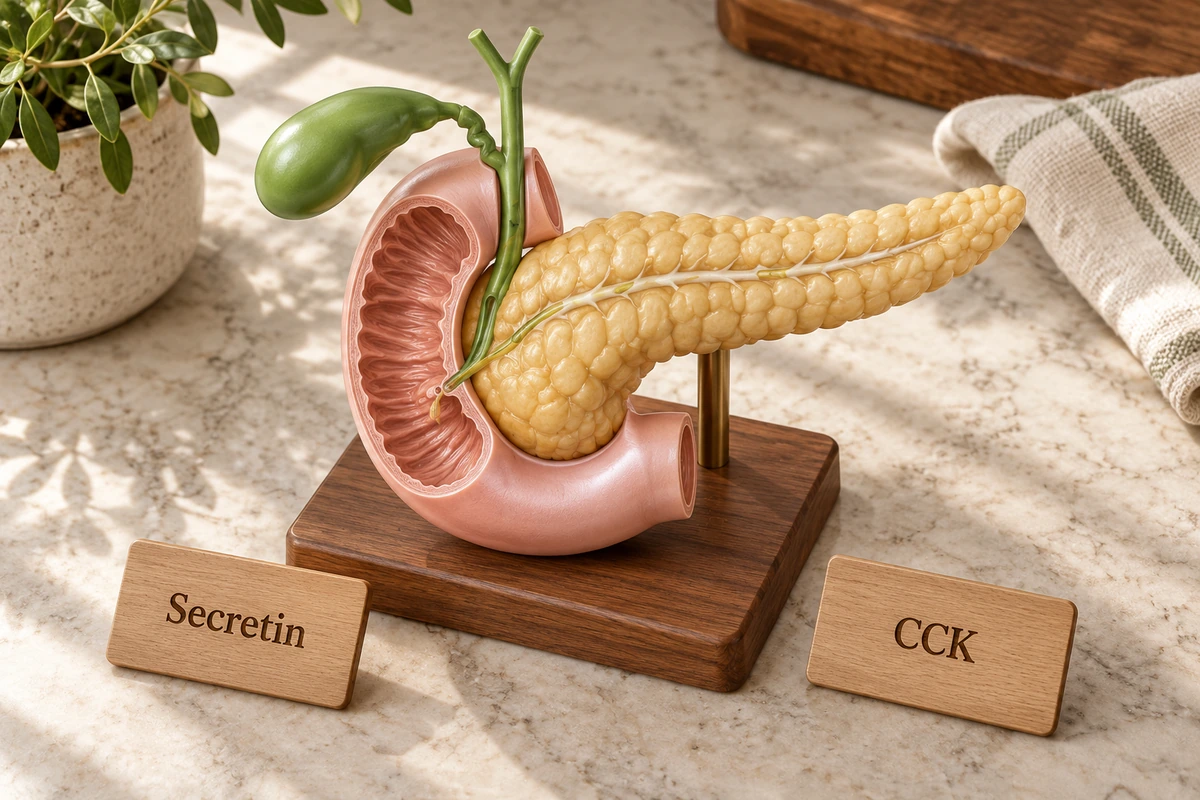
Two Signals With Different Jobs
| Hormone | Important Trigger | Main Function in This Discussion |
|---|---|---|
| Secretin | Acid entering the duodenum | Helps stimulate pancreatic bicarbonate secretion. |
| Cholecystokinin (CCK) | Products of fat and protein digestion | Helps stimulate pancreatic enzyme release and gallbladder contraction. |
These hormones are released from cells in the small-intestinal lining and act as part of a wider system of hormonal and nervous signals. A meal response is more complex than one switch being either on or off.[1][2][3]
Why Bicarbonate Matters
Food arriving from the stomach is acidic. Bicarbonate helps neutralize that acid in the duodenum so the environment supports further digestion. Campbell-McBride emphasizes this function when describing secretin and the pancreas.[1]
Bicarbonate and digestive enzymes have different jobs. One helps change the chemical environment; the others help break food down. Bile contributes to handling fat. The bile and fat-digestion guide explains that part of the same sequence.
What Stimulates CCK
Human studies support the role of fat, protein, and amino acids in CCK release. Liddle and colleagues measured responses to food and linked CCK activity with gallbladder contraction. Thimister and colleagues studied protein and amino acids delivered to the duodenum and measured CCK, gallbladder, and pancreatic-enzyme responses.[2][3]
That evidence is helpful because it shows why CCK should not be described as responding only to acidity. Protein digestion and meal composition also matter. These were controlled physiological studies, not tests readers can reproduce with a meal at home.
How the GAPS Book Uses Stomach Acidity
The 2020 book connects adequate stomach acidity with the hormonal response downstream. It gives a pH of 2 or below in its explanation of the two hormones and describes reduced pancreatic and bile responses when acidity is low.[1]
Campbell-McBride gives that threshold in her explanation. It does not establish that low stomach acidity means no CCK, no bile, no enzymes, or no digestion. Nor can symptoms after a meal show the pH or hormone levels involved.
Pancreatic Enzymes in the Same Chapter
Campbell-McBride places stomach-acid support ahead of enzyme supplementation in her own clinical approach. She also says that, when pancreatic enzymes help a patient, there is no reason not to use them if the preparation is suitable for GAPS. That allowance belongs in the explanation too.[1]
The chapter’s preference is not a direction to stop an indicated enzyme prescription or replace it with an acid supplement. The measured product, reason it was prescribed, and individual response need to stay with the person’s treatment plan.
Questions Worth Keeping Separate
- Are you trying to understand the book’s digestion sequence?
- Are you asking about an actual pancreatic diagnosis or test result?
- Are you reviewing a medicine or enzyme preparation already prescribed?
- Are you trying to identify why a particular meal caused symptoms?
The first question can be answered with the functional table above. The others need the actual findings, preparation, and symptoms. Combining them into “I need more acid” skips information that matters.
Your Next Step
Read bile and fat digestion for the meal response, or the pancreatic-duct guide for the obstruction discussion. Return to the organ overview if you want the wider map.
If you are putting the wider GAPS plan together, Understanding & Preparing for the GAPS Diet is listed in the WFLI shop.
References
- Campbell-McBride, Natasha. Gut and Physiology Syndrome (2020), “Stomach Acid” and pancreatic-enzyme supplementation discussion.
- Liddle, R. A., et al. Cholecystokinin bioactivity in human plasma: molecular forms, responses to feeding, and relationship to gallbladder contraction. Journal of Clinical Investigation (1985), 75:1144–1152.
- Thimister, P. W., et al. Role of intraduodenal proteases in plasma cholecystokinin and pancreaticobiliary responses to protein and amino acids. Gastroenterology (1996), 110:567–575.

Leave a comment