

The GAPS book describes gallstone passage as a painful episode followed by rest and a return to simpler foods. If you are reading because you have pain now, begin with the gallstone pain and urgent-assessment guide. Pain cannot tell you that a stone is moving safely through a duct.[1][2]
For understanding the chapter, three distinctions help: what the author says about passage, what a symptom can tell you, and what needs to be checked after the pain settles.
The Author’s Account of Passage
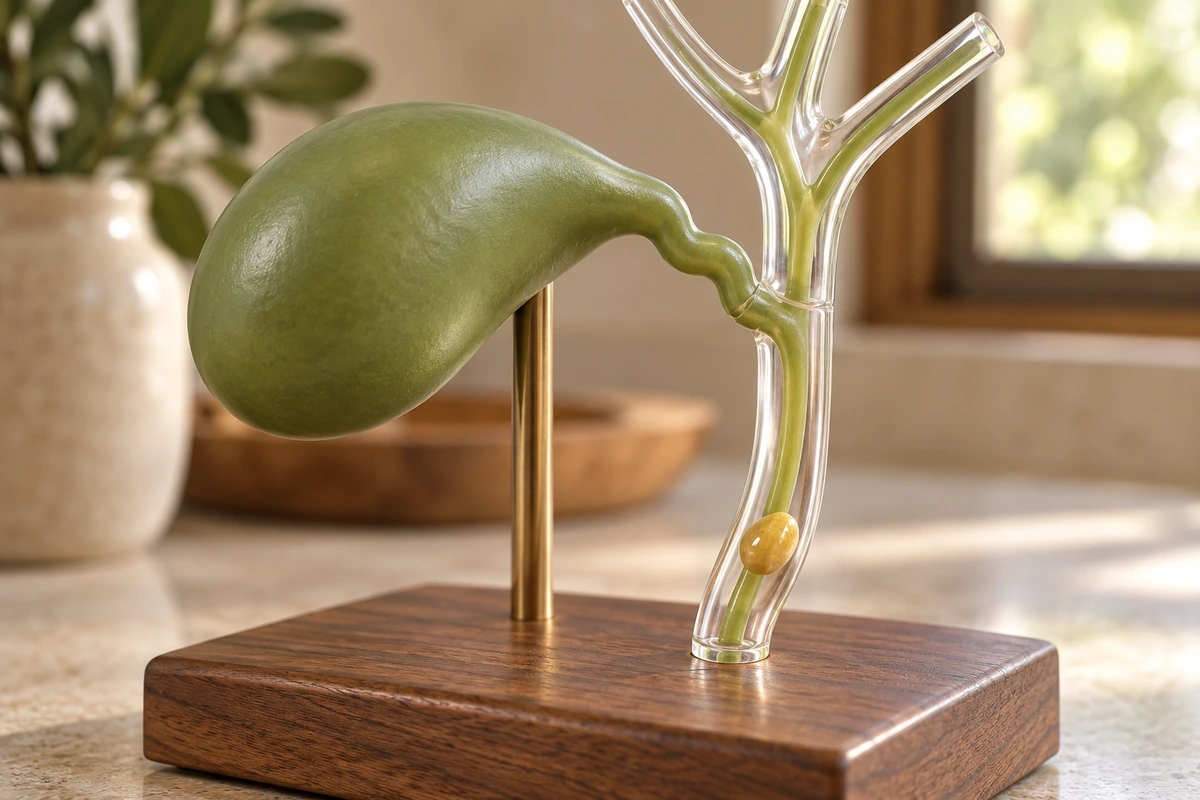
Campbell-McBride describes coordination between the liver, gallbladder, and pancreas as a stone moves toward the duodenum. She presents spontaneous passage as a process the body prepares for and contrasts it with induced interventions.[1]
That is the book’s account. It should not be expanded into reassurance that pain is never a warning or that an unassisted stone cannot lodge near the pancreatic outlet. Gallstones themselves are a common cause of acute pancreatitis.[3]
What Pain and Nausea Can Tell You
The book names pain, nausea, and vomiting. Those symptoms do not show the stone’s location or prove that it has already left the gallbladder. A stone may obstruct a duct, and inflammation or infection may be involved.[1][2]
| What You Notice | What It Does Not Establish |
|---|---|
| Pain after a meal | It does not locate a stone. |
| Pain easing | It does not prove that all stones or obstruction have cleared. |
| Nausea or vomiting | It does not distinguish routine passage from a complication. |
| A previous similar episode | It does not establish that the current episode will follow the same course. |
The Timing Described in the Book
Campbell-McBride gives a course of about fifteen to thirty minutes and, in some cases, up to three hours. These are durations in her description, not a three-hour interval to wait at home before seeking care.[1]
Record when symptoms began and arrange assessment for a suspected attack, particularly with ongoing pain, vomiting, fever, jaundice, dark urine, or pale stools.[2]
ERCP and a Home Flush Are Different
The book discusses ERCP and an oil-and-citrus “liver flush” together when describing the risk of pancreatitis. ERCP is a medical procedure that can treat obstructing duct stones and also has procedure risks. A home flush is not the same intervention.[1][4]
The book’s suggestion that a flush is safer years into GAPS does not establish an individual safe point for trying one. Having spent longer on the diet cannot show whether a duct is obstructed. An assessment also does not automatically mean that the gallbladder must be removed.
The Food and Rest Discussion Afterward
After an episode, the book describes rest, warm water or warm meat stock, and foods from Intro Stage 1 or Stage 2 for a few days. Keep that as the author’s recovery-food context after the problem has been assessed, rather than confirmation that symptom relief means the organs have fully healed.[1]
If you are given a recovery plan, clarify when and what you can eat and what should prompt another call. A GAPS food preparation still needs to match the stage and ingredients you tolerate. The chapter’s shake discussion belongs with its own measured recipe, not a new improvised formula during an attack.
Follow-Up Matters Even When You Feel Better
The book connects long-term GAPS with preventing repeated episodes. That is the author’s claim, not a guarantee that stones will not recur. Symptoms can settle while stones remain, so follow-up depends on the findings and the plan made for you.[1][5]
- Keep the symptom start and end times.
- Write down what the assessment found.
- Ask whether any obstruction remains.
- Keep the food, medicines, and follow-up instructions together.
Your Next Step
Use the urgent-assessment guide for symptoms happening now. For the longer explanation, read the GAPS stone-formation model and the pancreatic connection.
If you are putting the wider GAPS plan together, Understanding & Preparing for the GAPS Diet is listed in the WFLI shop.
For the wider organ map and the other guides in this series, return to Liver, Bile, and Lungs.
References
- Campbell-McBride, Natasha. Gut and Physiology Syndrome (2020), “The Liver and the Lungs.”
- NIDDK. Symptoms & Causes of Gallstones.
- NIDDK. Symptoms & Causes of Pancreatitis.
- NIDDK. Endoscopic Retrograde Cholangiopancreatography (ERCP).
- NIDDK. Treatment for Gallstones.

Leave a comment