

Gut and Psychology Syndrome gives two direct bedding instructions for a baby: use natural materials in the bed and stroller, and protect the mattress with a waterproof cover. It then gives a specific account of urine, microbes, chemical additives, toxic gases, and sudden infant death, with extra emphasis on a mattress already used by an older child.[1]
Choosing bedding can bring a long list of materials, labels, and product claims. Start with the mattress and cover you already have, or the ones you are comparing. This guide explains the GAPS books’ recommendations and gives you practical questions to ask about your baby’s sleep space.
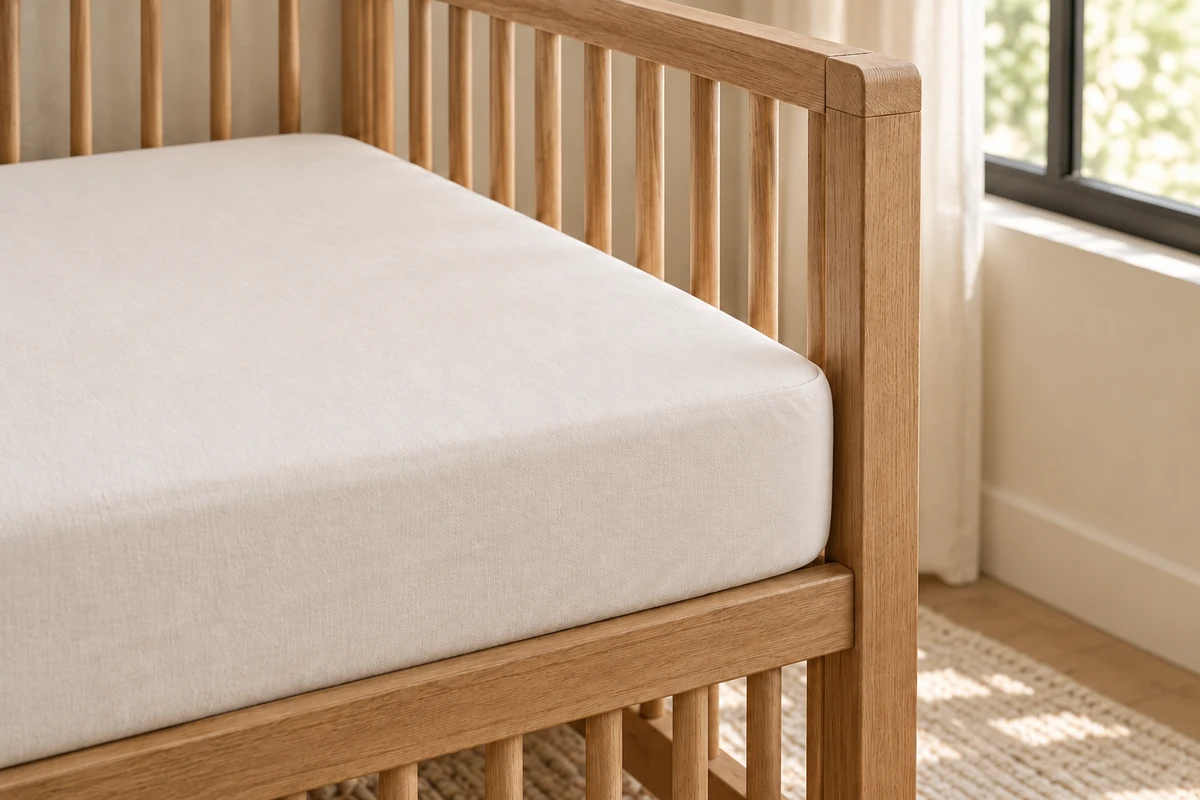
Natural Materials for Beds and Strollers
The source says to use natural materials for the baby’s bed and stroller.[1] It does not name one required fiber, mattress filling, foam, coating, cover fabric, waterproofing material, certification, brand, or stroller liner in this passage.[1]
When you compare products, ask about the materials in each one. The passage does not identify a particular product as the only option.[1]
For a baby who also has eczema, Dr. Natasha’s 2020 book adds fabric guidance in its Eczema section. She discusses superfine merino wool and emphasizes that its processing matters. For people with skin conditions, she advises avoiding synthetic materials and conventional cotton.[6] This is guidance for skin conditions, rather than one required mattress fiber for every baby. If eczema is part of your bedding decision, ask about the fabric and how it was processed.
The Waterproof-Cover Step
The book’s second instruction is to protect the mattress with a waterproof cover. The passage names the function of the cover but does not specify what it must be made from or how a particular product should be installed.[1]
Write down the mattress and cover names, whether another child used the mattress, and the manufacturer’s care and fit instructions. Keep those notes together so you can check the details when comparing what you have or asking the manufacturer a question.
The Mattress and Toxic-Gas Account in the Book
Campbell-McBride says urine entering some modern mattresses, especially a mattress already used by an older child, can react with microbes and chemical additives inside the mattress and release toxic gases. The book calls those gases the main cause of sudden infant death and gives the waterproof cover as its practical step.[1]
The wording above is the book’s claim and reasoning. The source does not use this paragraph to provide a complete safe-sleep setup, a mattress-testing method, a list of gases to test at home, or a product approval system.[1]
Research on the Toxic-Gas Hypothesis
A 1994 paper by B. A. Richardson investigated the hypothesis that phosphines, arsines, and stibines generated from mattress materials could be a primary cause of sudden infant death. The paper reported fungal contamination in mattress areas affected by infant warmth and perspiration and proposed a gas-generation mechanism involving materials containing phosphorus, arsenic, or antimony compounds.[2]
A 2002 Scottish case-control study compared 131 sudden-infant-death cases with 278 matched controls. Routine use of a mattress previously used by another child was associated with increased risk, and the association was stronger when the mattress came from another home. The authors said the evidence was not enough to determine whether the relationship was causal.[3]
These studies address parts of the book’s mattress account: a proposed microbial-gas mechanism and an observed association with used mattresses. They do not supply the fiber, foam, coating, waterproofing, or brand details that the GAPS passage itself leaves unnamed.[2][3]
The toxic-gas explanation has not been established as the cause of SIDS; NICHD states that its exact cause remains unknown. A waterproof cover should not be presented as proven SIDS prevention. Use a firm, flat, level infant sleep surface with a fitted sheet and no loose bedding, and check that any cover fits the mattress and follows the manufacturer’s instructions.[5]
A Simple Bedding Record
| Record | What to Note |
|---|---|
| Bed or stroller item | The source applies its natural-material instruction to both.[1] |
| Mattress product and age | Identifies the mattress you actually have. |
| Previously used by another child | The source gives extra emphasis to a used mattress.[1] |
| Waterproof cover present | Records the practical step named in the passage.[1] |
| Manufacturer information saved | Keeps the actual product, fit, care, and material information available without guessing. |
| Questions still open | Separates missing information from assumptions. |
How This Fits the Wider Newborn-Care Plan
Bedding is one part of the wider Baby GAPS newborn-care and home plan. That guide also covers fresh air and sleep, baby skin care, cleaning and renovation timing, household exposures, and vaccination planning.
Start with the place the baby sleeps, then use the parent guide for the rest of the home plan. For this decision, identify what the baby sleeps on, record whether it was previously used, and record the waterproof cover the source names.
What This Looked Like in Our Home
In our home, we changed the laundry detergent, removed fabric softener, rewashed clothes and sheets, made laundry and dishwasher detergents, made lotions and balms, and used a Berkey water filter.[4]
Those changes involved the things touching our clothes, sheets, skin, dishes, and water every day. They are the home changes I can share from our own experience.[4]
Work Through the Home One Room at a Time
The Low-Tox GAPS Home turns the book’s home section into a practical, budget-aware room-by-room plan.
Frequently Asked Questions
Does the Source Name One Required Bedding Material?
No. It says natural materials for the baby’s bed and stroller. It does not name one required fiber, filling, foam, coating, certification, brand, or stroller product in this passage.[1]
Does the Source Name a Waterproof-Cover Material?
No. It names a waterproof mattress cover as the practical step but does not name the material in this passage.[1]
Does the Source Say Every Used Mattress Causes Toxic Gas?
The passage says urine can react inside some modern mattresses and gives extra emphasis to a mattress already used by an older child. It does not say every used mattress produces gas in every situation.[1]
What Did the Used-Mattress Study Find?
The Scottish study found an association between routine use of a mattress previously used by another child and sudden infant death, strongest when the mattress came from another home. The study did not establish causation.[3]
Does This Guide Recommend Buying a New Mattress?
The source passage does not give a general new-mattress purchasing instruction. It says natural materials, names a waterproof cover, and explains its concern about some modern and previously used mattresses.[1]
References
- Campbell-McBride, Natasha. Gut and Psychology Syndrome, second German edition (2015), “Nahrung ist nicht alles,” baby bedding and mattress discussion. English wording here is translated from that supplied edition, based on the expanded English edition (2013).
- Richardson, B. A. “Sudden Infant Death Syndrome: A Possible Primary Cause.” Journal of the Forensic Science Society (1994). PubMed 7523575.
- Tappin, D., Brooke, H., Ecob, R., and Gibson, A. “Used Infant Mattresses and Sudden Infant Death Syndrome in Scotland: Case-Control Study.” BMJ (2002). PubMed 12411359.
- Garnica, E. WFLI Family Story Source, eczema and low-tox home sections, current through October 2026.
- NICHD. Sudden Infant Death Syndrome and Safe Sleep Environment.
- Campbell-McBride, Natasha. Gut and Physiology Syndrome (2020), A–Z, “Eczema,” fabric and processing discussion.
The personal beliefs, opinions, philosophies, and/or views shared in this article are solely based upon my own GAPS experience and may not align with nor reflect the views of GAPS or Dr. Natasha Campbell-McBride, or the content in Dr. Natasha’s GAPS books, podcasts, blog posts, social media posts, or training courses.

Leave a comment