

The GAPS personal-care approach is to simplify what goes on the skin, scalp, and teeth. Campbell-McBride names ingredients she wants readers to avoid and describes edible oils, fats, and other household options. If you are reviewing a bathroom shelf, it helps to separate that approach from the safety questions about a particular product.[1]
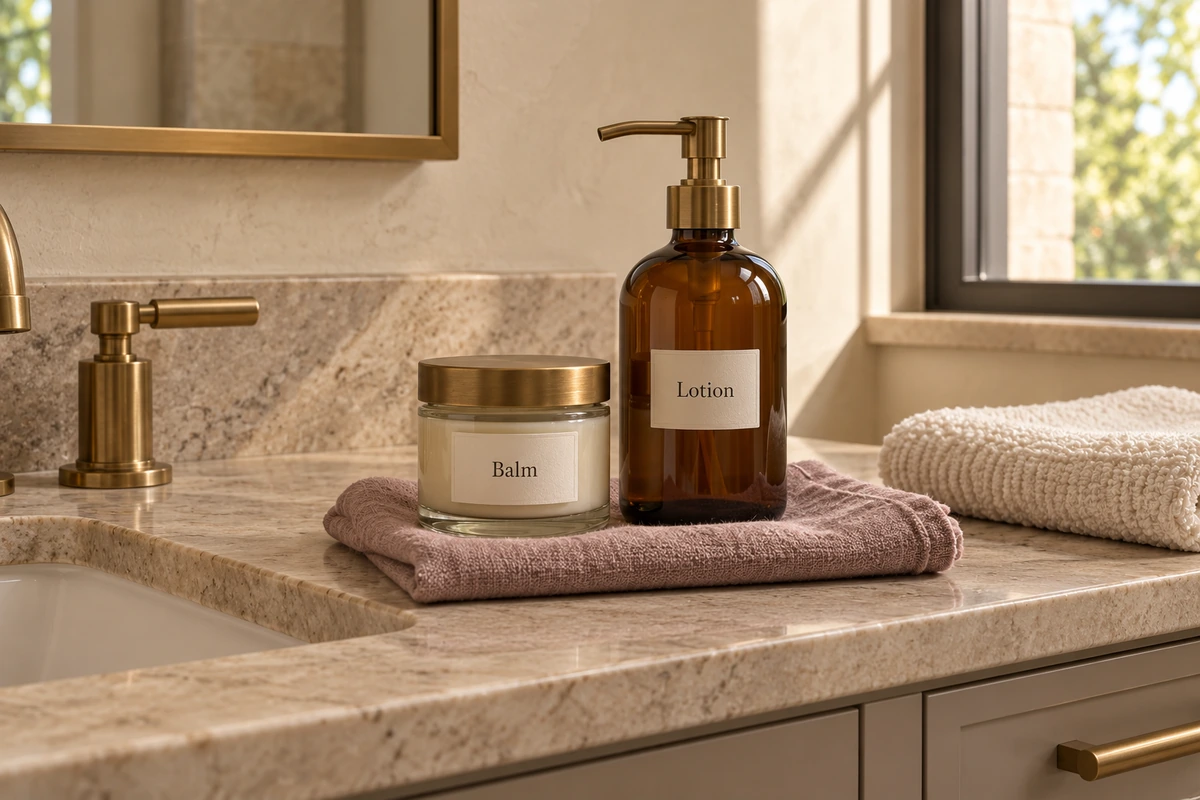
We made our own lotions and balms as part of our family’s home changes. I can share that choice without claiming every homemade mixture suits every person or replaces a treatment their skin needs.
Skin Is a Selective Barrier
The book argues that skin exposure deserves attention and points to medicines delivered through patches. Some substances can pass through skin, but skin is still a barrier. NIOSH describes how absorption depends on the chemical, concentration, contact time, body site, and condition of the skin. A drug designed for transdermal delivery does not show that every cosmetic enters the bloodstream in the same way.[1][2]
That distinction is useful when reading a label. “It touches skin” is not enough to determine the amount absorbed or the effect. A leave-on product, a rinse-off product, and a concentrated ingredient are different situations.
The Ingredients Named in the Book
Campbell-McBride lists talc, sodium lauryl or laureth sulfate, fluoride, titanium dioxide, TEA and DEA, lanolin, dioxanes, saccharin, formaldehyde, propylene glycol, and metals such as lead and aluminum. The list records her concerns; the ingredients do not all have the same evidence, exposure route, or risk.[1]
| Ingredient or Group | A Useful Distinction |
|---|---|
| Talc | IARC classifies talc as probably carcinogenic. That is a hazard classification, not proof that every talc use or product causes ovarian cancer.[5] |
| SLS and SLES | These are different surfactants, not interchangeable names. Irritation and impurities need product-specific context.[12] |
| Titanium dioxide | Do not transfer an inhaled-particle concern to every topical use. FDA evaluates sunscreen actives by their intended use.[10] |
| TEA, DEA, and lanolin | Formulation, impurities, and supplier information matter. A name alone does not establish a contaminant level.[12] |
| 1,4-Dioxane | FDA describes it as a possible trace manufacturing byproduct, rather than an intentionally added cosmetic ingredient.[6] |
| Saccharin and propylene glycol | The book’s blanket carcinogen labels should not be treated as established human-cancer findings.[7][8] |
| Formaldehyde and metals | A specific substance, route, amount, and product are needed to assess risk; do not treat all metals or all cosmetic products as equivalent. |
This is a reason to ask a better question about a product, not a reason to guess. Keep the ingredient list and the intended use together. If a contamination claim concerns a particular batch or product, look for the actual alert or testing information rather than extending it to every product in the category.
Cosmetics Regulation Has Changed Since the Book
The 2020 book describes the industry as self-regulated. That is not a complete current description in the United States. MoCRA expanded FDA authority and added requirements including safety-substantiation records and serious-adverse-event reporting. Many cosmetics do not receive FDA approval before sale, but that is different from saying there is no regulation or responsibility for safety.[1][3]
Deodorant and Antiperspirant Are Different
The book links underarm products and aluminum to its concerns about breast cancer. NCI reports no clear evidence that aluminum-containing antiperspirants increase breast-cancer risk. Deodorants address odor; antiperspirants reduce sweating. Those product functions should not be combined into one claim that every deodorant stops sweating.[1][4]
Campbell-McBride suggests a little fresh lemon juice for odor. That remains the author’s suggestion, not a guarantee that lemon will be comfortable on every person’s skin.[1]
How the Book Approaches Everyday Products
| Routine | What Campbell-McBride Describes |
|---|---|
| Hair washing | Egg yolks separated from the whites, used in place of shampoo. |
| Moisturizing | Edible fats and oils, including coconut and olive oil; she particularly favors tallow for dry skin. |
| Body washing | Water and a sponge rather than soap, shower gel, or bubble bath, especially for babies and children. |
| Oral care | Olive oil, zeolite or bentonite powder, and occasional charcoal or bicarbonate of soda. |
These are the book’s options. Edibility alone is not a test of topical safety or a reason to stop a prescribed skin treatment. Nor does calling a mineral powder natural establish that it is purified or suitable for teeth.[1]
Oral care needs its own distinction. Oil pulling means swishing oil around the mouth; it is not simply brushing with oil. It is not an established substitute for fluoride toothpaste and appropriate dental care. Keep an individual dental recommendation with your dentist rather than treating every topical fluoride use as poisoning.[9][11]
The Part That Comes From Our Family
We made lotions and balms, changed laundry products, and stopped using fabric softener. Those choices were part of the broader home changes we made while following GAPS. The household guide describes the other changes we made alongside our skin-care choices.
If you want to review your own routine, start with the products you use most often. Write down where each one is applied, whether it is rinsed off, and what question you actually need answered. You can simplify a routine without making an unsupported claim about everything left on the shelf.
Keep Product Questions in One Place
The Low-Tox GAPS Home and the Home Product Label Red Flags card are listed in the catalog. The catalog also includes skin-care and bath resources.
Your Next Step
Choose one daily-use product and keep its full label with your question. For cleaners, laundry, air, and drinking water, continue with the household guide.
References
- Campbell-McBride, Natasha. Gut and Physiology Syndrome (2020), “Detoxification for People with Gut and Physiology Syndrome,” personal-care passages in “1. Reduce your general toxic load”.
- NIOSH. Skin Exposures and Effects.
- FDA. Modernization of Cosmetics Regulation Act of 2022.
- National Cancer Institute. Antiperspirants/Deodorants and Breast Cancer.
- IARC. Carcinogenicity of Talc and Acrylonitrile.
- FDA. 1,4-Dioxane in Cosmetics: A Manufacturing Byproduct.
- National Cancer Institute. Artificial Sweeteners and Cancer.
- ATSDR. Propylene Glycol: ToxFAQs.
- American Dental Association. Home Oral Care.
- FDA. Questions and Answers: FDA’s Regulatory Actions for Over-the-Counter Sunscreen.
- American Dental Association. Oil Pulling.
- Health Canada. Safety of Cosmetic Ingredients.

Leave a comment