

Starting GAPS means learning a new set of GAPS diet foods to avoid, and the fastest way to get there is by ingredient, not by product name. Bread, pasta, cereal, potatoes, bottled sauces, and most packaged snacks and drinks all need a different approach in your kitchen. The label on the front of a box won’t tell you what you need to know, so read the ingredient list instead.
This kind of list becomes easier to use once it leads somewhere, turning an exclusion into an actual meal instead of another column of foods you cannot eat. If ordinary pasta is off the table, what goes under the meat sauce? If cereal is out, what’s ready by 7am?
This guide covers the main exclusions, the ingredient details that are easy to miss, and the swaps that turn an exclusion into dinner. The full list of what you can eat lives in the Intro + Full GAPS Food List. Here, the focus stays on what’s out.
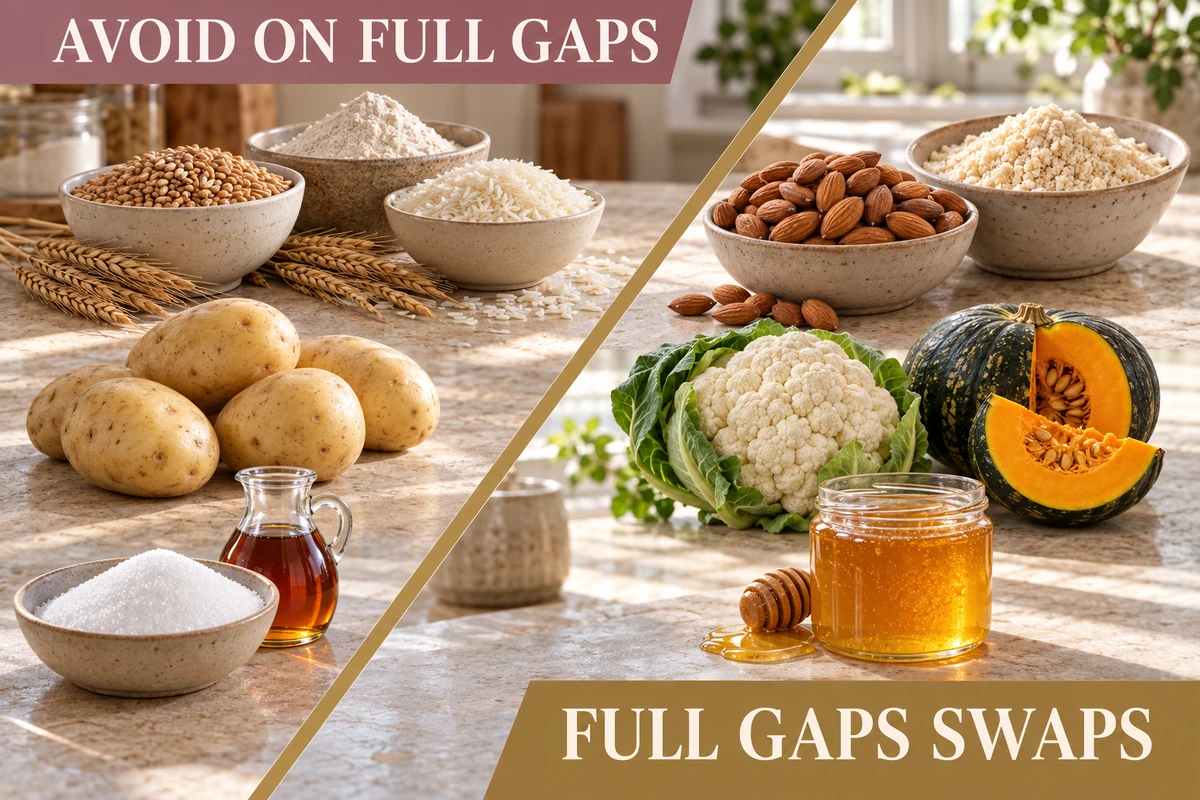
Your GAPS Stage Still Changes the Answer
A substitute has to pass two checks: its ingredients belong in the GAPS route you are following, and its preparation fits the current stage or food form. A Full GAPS alternative is not automatically an early-Intro alternative.
Some plants have specific readiness conditions. The 2020 book lists aloe vera with permission to introduce it once digestive symptoms are gone, and fresh or dried seaweed after the Introduction Diet is complete. In her FAQ, Dr. Natasha explains the aloe-and-seaweed restriction in the context of profuse diarrhea and ulceration, allowing introduction once those symptoms have gone and digestion is functioning fairly well.[9]
Check the Phase Before the Swap. Use Intro GAPS versus Full GAPS to identify the route, the stage-by-stage Intro guide for the full progression, and the food list for the exact ingredient. Coming off GAPS is a separate later transition. This page stays focused on exclusions, label decisions, and usable meal swaps.
Grains and Other Foods Not Allowed on GAPS
Standard GAPS excludes wheat, rice, oats, corn, barley, rye, and millet. That exclusion carries over to anything made from them: ordinary bread, pasta, crackers, breakfast cereal, pastries, breadcrumbs, and most baking mixes.[6]
GAPS groups quinoa and buckwheat with grains, though their botanical classification is different. Both sit outside standard Intro and Full GAPS, with their place considered separately if you transition off the diet later.[6]
A gluten-free label doesn’t settle the question. Rice flour and corn flour are both gluten-free and both outside standard GAPS. A gluten-free loaf or pasta often leans on potato starch or tapioca to hold together. A gluten-free label does not make a product GAPS-friendly.[4][6]
Read the actual ingredient list, especially on anything marketed as a substitute for a familiar food. Solving for gluten doesn’t mean solving for GAPS.
Starchy Vegetables and Hidden Thickeners
Potatoes, sweet potatoes, yams, parsnips, and Jerusalem artichokes are standard exclusions. French or globe artichokes are a different vegetable entirely, so don’t treat the names as interchangeable just because they share a word.[4][6]
The ingredients made from those excluded foods matter too. Potato starch, cornstarch, and tapioca show up as thickeners in sauces, soups, gravy, coatings, and gluten-free baking mixes, without announcing themselves on the label.[4]
GAPS doesn’t exclude every root vegetable, though. Carrots and turnips have a place on GAPS food lists, and squash is another useful stand-in. The specific vegetable matters more than a broad category like “roots.”[4][6]
For a side dish, try cauliflower mash or a suitable squash preparation instead of potatoes. For a sauce or soup, reach for a recipe built around GAPS-friendly ingredients instead of the usual flour or starch thickener.
Sugar and Sweeteners
Refined sugar, corn syrup, maple syrup, agave, molasses, and artificial sweeteners are outside standard GAPS. Honey has its own place in the program, but that doesn’t make every sweetener with a natural-sounding name equivalent to it.[4][6]
For the separate question of cocoa and chocolate, read my sugar and chocolate cravings guide. It keeps the book’s later-introduction discussion and the FAQ’s pure-cocoa guidance together.
Coconut sugar is not a stand-in for honey on GAPS. Coconut flesh, coconut oil, and coconut sugar are three different products, and the word “coconut” on the front of a package doesn’t settle whether an ingredient fits.[5]
Check sweetened drinks, bottled sauces, nut butters, dried fruit, and ready-made desserts, not just the obvious sweets. Sugar shows up in foods that don’t taste sweet at all, including savory sauces and some prepared meats.
“No added sugar” doesn’t mean it fits GAPS. A product can still contain another excluded ingredient, and a sugar-free version might lean on an artificial sweetener instead. Read the whole list rather than stop at one claim on the label.
Dairy: Why It Isn’t a Simple Avoid List
Dairy needs more nuance than a flat avoid list. GAPS distinguishes particular natural cheeses and homemade cultured foods from ordinary milk drinks and most processed dairy products.[4][6]
Commercial yogurt, processed cheese products, milk-based drinks, and prepared dairy desserts don’t fit just because dairy itself isn’t a flat exclusion. One natural cheese on a GAPS list isn’t permission to reach for the cheese spread beside it.[4][6]
Homemade whey drained from properly fermented GAPS yogurt or kefir, along with homemade yogurt, homemade kefir, and homemade sour cream, can start in small amounts as early as Stage 1, if you tolerate them. If eczema, acne, dermatitis, or another skin condition is part of the picture, GAPS notes you may want to temporarily eliminate all dairy, homemade included, before working it back in.[6][1]
There’s a separate official Dairy Introduction sequence[3] for anyone who needs to go slower with dairy. If you’re starting from Full GAPS rather than Introduction, check whether it applies to you first.
Beans, Soy, and Prepared Legumes
In Gut and Physiology Syndrome (2020), the ordinary recommended list names dried white or navy/haricot beans, dried or fresh lima beans, string beans, lentils and split peas. The book’s later “Double-Fermented Beans” recipe gives a wider permission for mixtures of beans, lentils or dried peas, but only with that complete double-fermentation preparation. It does not make every legume an ordinary GAPS food after soaking or one unrelated ferment. Keep the variety, preparation and digestive readiness together when choosing a recipe.[8]
Chickpeas, soy, and other legumes aren’t equivalent. Chickpea pasta may be grain-free, but that doesn’t mean it fits GAPS, and a tin of prepared baked beans needs more than a glance at the bean variety since the sauce often carries sugar or other excluded ingredients.
Soy milk, tofu, and soy-based sauces sit outside standard GAPS. A gluten-free label doesn’t rule out soy, and tamari isn’t a substitute for soy sauce just because it skips wheat.[6]
Prepared Meat, Sauces, and Seasonings
A plain cut of meat and a prepared meat product can carry very different ingredient lists. Breadings, marinades, fillers, sweeteners, and sauces are common places for excluded ingredients to hide.
Check sausages, deli meats, ready-made meatballs, breaded fish, and marinated products carefully. A familiar name like chicken or beef doesn’t tell you everything that’s in the finished food.
Stock cubes, soup mixes, bottled dressings, ketchup, and ready-made sauces deserve the same scrutiny, since their ingredients still count toward the meal.
Cooking method matters too. Roasted and grilled meat, not fried or barbecued and without burned bits, enters at Stage 4. Fresh herbs are fine much earlier, but ground spices wait until Stage 6.[6][1]
Plain tomato products, herbs you recognize, and a sauce built from ingredients you understand simplify the decision.
Baking Ingredients and Nuts
GAPS baking works differently from ordinary grain-based baking. Check the sweetener, fat, raising agent, and any extras, not just the flour.
The book also explains why preparation matters for plant foods. Dr. Natasha names enzyme inhibitors, lectins, mineral-binding phytates and oxalates, and iodine-binding glucosinolates in brassica vegetables. Her practical instruction is to leave out the worst offenders and prepare permitted vegetables, nuts and legumes carefully. Use the preparation for the particular food and the form of GAPS you are following.[10]
Baking powder and mixed raising-agent products remain outside Full GAPS. Pure bicarbonate of soda is allowed for source-measured GAPS baking and for the specified white navy/lima bean preparation; it is not interchangeable with baking powder. The official FAQ also describes a separate, narrow health-related use[5], separate from its baking and bean-preparation roles. Follow the specific recipe rather than reach for whatever leavening is in the pantry.[6][12]
Nuts need their own check too. Salted, coated, sweetened, and flavored nuts differ from plain nuts prepared at home. Chestnuts and chestnut flour are excluded on standard GAPS: the 2020 Gut and Physiology Syndrome lists them under “Foods to Avoid” on page 138, and the current official online list agrees.[6][4] The older Gut and Psychology Syndrome listed chestnuts among allowed nuts, but the newer book takes precedence on this updated food-list question.[7] Choose a different established GAPS recipe rather than treating chestnut flour as interchangeable with another flour.
Nut butter and nut flour aren’t interchangeable. Nut butter shows up first, in the Stage 3 pancake method and on its own. Nut-flour bread waits for Stage 4. Swapping one for the other changes a batter, so treat it as a cooking question, not just a food-list one.[6][1]
Fats and Drinks
Not every oil has the same place on GAPS. Coconut oil is a Stage 1 food and stays an approved cooking fat through Full GAPS. Animal fats like tallow, lard, and duck fat start at Stage 1, and ghee joins at Stage 2.[6][1]
In Dr. Natasha’s digestion explanation, fats require bile and ordinarily need little work from the enterocytes, the cells lining the small intestine. She also describes impaired bile flow and excess mucus coating food as reasons fat may still be difficult to digest.[11] My bile and fat-digestion guide follows that question separately.
Cold-pressed olive oil is different: it’s meant to be used raw, not for cooking, and doesn’t enter until Stage 4. A bottle labeled “vegetable oil” isn’t a stand-in for either.[6]
Fresh vegetable juice enters at Stage 4, starting with a few teaspoons of carrot before lettuce, cucumber, celery, and herbs join in. Fruit juice joins the established vegetable juice at Stage 5, starting with apple, pineapple, or mango. Citrus fruit and citrus juice remain out at that stage; the earlier lemon-water use is separate. Juice from a carton isn’t the same as juice you’ve pressed yourself.[6][1]
Sweetened soft drinks, commercial fruit drinks, and most flavored beverages sit outside the usual plan. Full GAPS allows weak, freshly brewed coffee and tea, but not instant coffee or heavily sweetened drinks. Alcohol guidance for adults is a separate topic, apart from Introduction.[6]
Three Label Checks Before It Goes in the Cart
A product can look like it fits at first glance and still need a closer read. These are patterns to check, not claims about any particular brand.
| Product Description | What to Look For |
|---|---|
| Gluten-free bread | Rice flour, potato starch, tapioca, sugar, and the rest of the ingredient list |
| Natural peanut butter | Added sweeteners, oils, and other extras, plus whether nuts fit your current stage |
| Organic tomato sauce | Sugar, starches, prepared flavorings, and any ingredient that doesn’t fit your recipe |
| Illustrative Tomato-Sauce Label | Decision |
|---|---|
| Organic tomatoes | The ingredient can fit Full GAPS; on Intro, check the stage, cooked form, and nightshade tolerance. |
| Water and sea salt | No exclusion appears in these two ingredients. |
| Organic cane sugar | Explicit exclusion. This is enough to reject the product. |
| Potato starch | Explicit exclusion on standard Intro and Full GAPS. This also rejects the product. |
| Natural flavor | Unclear. Ask the manufacturer what it contains; do not guess from the phrase. |
Decision: do not buy this illustrative product because the sugar and potato starch are explicit exclusions. The unclear flavoring still deserves an answer, but it does not cancel the two already-settled reasons to leave the jar on the shelf. This is a teaching example, not a claim about any brand.
When an ingredient is unclear, choose a simpler product or ask the manufacturer a direct question. A similar-looking product on a website you found somewhere else can’t tell you what’s actually in the one sitting in your cart.
GAPS Ingredient Swaps That Lead to Meals
Shopping gets easier once you know the replacement meal. These swaps only work where the ingredients and preparation already fit your current stage, so check that first.[6]
| Familiar Food | A GAPS Alternative to Try |
|---|---|
| Ordinary pasta with meat sauce | A suitable meat sauce over spaghetti squash or another vegetable |
| Potatoes with a roast | Cauliflower mash or an appropriate squash side |
| Sweetened breakfast cereal | Eggs and vegetables, or another prepared meal from your current stage |
| A conventional sandwich | For Full GAPS, pack a reserved serving of the slow-cooker pot roast with turnips and carrots in a glass container. For Intro, pack a stage-appropriate soup using the chicken meat stock and soup preparation notes. |
| Sweetened shop-bought yogurt | If dairy is introduced, use plain homemade cultured dairy. If it is not, a concrete Full GAPS breakfast is eggs with cooked spinach and tomato when eggs and nightshades are tolerated; on Intro, use a complete meal already established for that stage. |
You don’t need to recreate every old food right away. A straightforward meal beats a complicated substitute recipe that pulls in several new ingredients at once.
Keep the Food List Where You Plan Meals
For the bigger picture before you get deeper into ingredient specifics, What Is the GAPS Diet? A Clear Guide to the Basics lays out Intro and Full GAPS side by side. Get the Intro and Full GAPS Food List and keep it nearby while you shop. Then use the Full GAPS meal guide to turn the allowed alternatives into complete meals.
FAQ: GAPS Diet Foods to Avoid
Is Quinoa Allowed on the GAPS Diet?
No. GAPS groups quinoa with grains, even though it’s technically a seed. It sits outside both standard Intro and Full GAPS, with its place considered later during a personal transition off the diet.[6]
Can I Eat Gluten-Free Bread on GAPS?
Not typically. Gluten-free doesn’t mean GAPS-compliant. Most gluten-free bread relies on rice flour, potato starch, tapioca, or added sugar, all of which sit outside standard GAPS regardless of the label.[4][6]
Are Potatoes and Sweet Potatoes Allowed on GAPS?
No, both are standard exclusions, along with yams and parsnips. Carrots, turnips, and squash are common stand-ins, and it’s worth checking packaged sauces and gravies for potato starch too.[4][6]
Is Coconut Sugar an Acceptable Substitute for Honey on GAPS?
No. Coconut sugar isn’t interchangeable with honey on GAPS. Coconut flesh, coconut oil, and coconut sugar are three separate products, and only some coconut products fit the plan.[5]
Is Tamari GAPS-Friendly Since It’s Often Wheat-Free?
No. Tamari is a soy-based sauce, and soy sits outside standard GAPS regardless of whether a particular tamari happens to skip wheat.[6]
Start With One Swap Tonight
Pick one meal from the swap ideas above: spaghetti squash under a meat sauce, or cauliflower mash beside a roast. Check what you already have on hand against your current stage, then cook that tonight instead of reaching for a packaged substitute.
For a closer look at particular foods and drinks, read my guides to carbohydrates, soy, beer, soft drinks and sweet potato.
For help with particular foods and ingredients, read my guides to gluten and casein, processed foods, breakfast cereal, grain flour, sugar and honey and acrylamide and cooking.
References
- GAPS Diet. “GAPS Introduction Diet Survival Guide: Six Stages of GAPS Intro.”
- Campbell-McBride, N. “GAPS Diet: Full Spectrum of the GAPS Diet.”
- GAPS Diet. “Dairy Introduction Structure.”
- GAPS Diet. “Full GAPS Diet: Recommended Food List and Foods to Avoid List.”
- Campbell-McBride, N. GAPS FAQs, including “Diet/Food” and the source-defined bicarbonate guidance.
- Campbell-McBride, N. Gut and Physiology Syndrome (2020), Chapter 11, food forms, recommended foods and exclusions; Chapter 13, “GAPS Introduction Diet,” food and cooking-method stages; Chapter 14, “The Full GAPS Diet” and dairy introduction; “Foods to Avoid,” p. 138: “Chestnuts and chestnut flour.” The raising-agent entry excepts pure bicarbonate of soda.
- Campbell-McBride, N. Gut and Psychology Syndrome, “Nuts and Seeds,” p. 112, and the older recommended-food list. This earlier allowance is superseded for the current food-list question by the 2020 book.
- Campbell-McBride, Natasha. Gut and Physiology Syndrome (2020), “Beans, Legumes and Pulses,” “Fermented Legumes” and “Double-Fermented Beans,” ordinary varieties, preparation-dependent exception and tolerance limits.
- Campbell-McBride, N. Gut and Physiology Syndrome (2020), “Foods to Avoid,” aloe vera qualifier, and “Recommended Foods,” seaweed after Intro; GAPS FAQs, “Aloe Vera,” question 1.
- Campbell-McBride, N. Gut and Physiology Syndrome (2020), food digestion and antinutrients, plant-food preparation.
- Campbell-McBride, N. Gut and Physiology Syndrome (2020), “Fats,” bile, enterocytes and mucus in fat digestion.
- Corrado, M. The Complete Cooking Techniques for the GAPS Diet, 2nd ed., Section X, Chapter 7, “Let’s Talk About Beans and Legumes in the GAPS Diet,” pp. 187–190, including the pure bicarbonate and alkaline-soaking note.

Leave a comment