

Rosemary, lemon, and mustard balance the rich liver in this smooth, chilled pâté. The onions soften alongside the livers, then dry white wine cooks down with the aromatics before everything is blended with butter and cultured crème fraîche. Make it ahead so it has time to set before serving.
Liver is one of the hardest GAPS foods to get on the table with any enthusiasm. A chilled pâté handles that differently from the ground-beef trick most of us lean on: the rosemary and lemon do the heavy lifting, and the texture is closer to a spread than to a slice of organ meat. You still get the full pound of liver into eight servings.
In our house, organ meats are the one category nobody looks forward to, so we usually hide them in ground beef meals. The other thing that makes a recipe like this realistic is having cultured dairy already in the fridge. We make yogurt, kefir, ghee, and sour cream in weekly batches, so a quarter cup of long-cultured crème fraîche is not a special errand. If you culture your own cream on a schedule, this pâté fits into that rhythm without extra planning.
Prep time: 15 minutes
Cook time: About 20 minutes, or until the livers reach 165°F
Cooling time: 20 minutes
Total before chilling: About 55 minutes
Chilling time: At least 4 to 5 hours
Yield: 8 servings
Ingredients
- 3 tablespoons unsalted butter for the skillet
- 1 pound chicken or duck livers
- 1 yellow onion, chopped
- 2/3 cup additive-free dry white wine
- 2 cloves garlic, mashed
- 1/2 teaspoon pure dry mustard powder without additives
- 1 teaspoon chopped fresh rosemary
- 1 tablespoon fresh lemon juice
- 2 tablespoons unsalted butter for blending
- 1/4 cup homemade crème fraîche cultured for at least 24 hours, after cultured dairy has been introduced and tolerated
- Natural mineral salt, to taste
A few notes on what each ingredient is doing. The skillet butter is the cooking fat, and it also carries the onion flavor into the livers. The blending butter goes in warm and gives the finished pâté its firm, sliceable set once it chills, so it is not a garnish you can skip. The livers should be fresh, trimmed of any greenish spots and connective strings, and patted dry before they go into the pan; wet livers steam instead of browning.
The dry white wine is the recipe’s liquid and its acid. Buy an additive-free bottle and use only the measured 2/3 cup. Dry mustard powder should be a single-ingredient jar with no starch or anti-caking agent. Fresh rosemary matters here; dried rosemary stays woody in a blended spread. Fresh lemon juice, not bottled, keeps the flavor clean.
The crème fraîche is a cultured, fermented dairy food. Cultured for at least 24 hours means the culture has had time to work through the lactose, which is why this recipe calls for the long culture rather than a short commercial one. Use it only after cultured dairy has been introduced and tolerated in your GAPS sequence. If you make your own, pull it from the fridge when you start cooking so it is not ice cold at blending time.
Make the Pâté
- Melt the 3 tablespoons of skillet butter in a large stainless-steel or enameled cast-iron skillet over medium heat.
- Add the livers and chopped onion. Cook, stirring occasionally, for about 10 minutes. The onion should soften and the liver edges should brown, but the livers should not become dry.
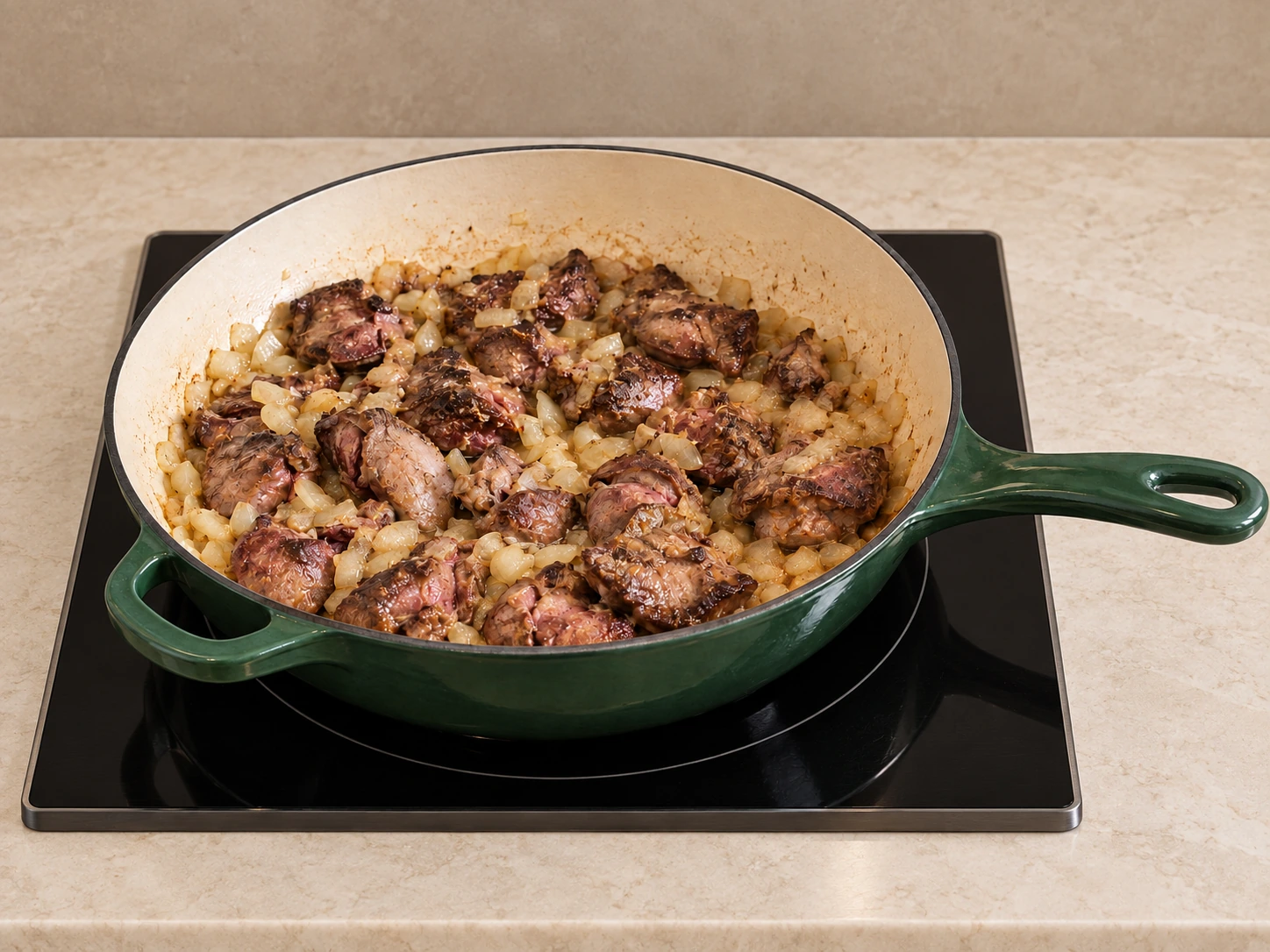
- Add the dry white wine, garlic, mustard, rosemary, and lemon juice. Bring to a simmer and cook uncovered for about 10 minutes, stirring occasionally, until no pool of liquid remains.
- Check the center of the largest liver with a food thermometer. It must reach 165°F before blending. If needed, continue cooking, checking again until it does.
- Remove the skillet from the heat and let the liver mixture cool for 20 minutes.
- Transfer the warm mixture to a food processor. Add the separate 2 tablespoons of butter and the 1/4 cup cultured crème fraîche. Process until smooth, scraping down the bowl as needed.
- Add mineral salt to taste and pulse to distribute it. Spoon the pâté into a crock or mold, cover, and refrigerate for at least 4 to 5 hours before serving.
What to Look for at Each Step
The onions should look soft and translucent, while the liver edges turn brown. Color alone cannot tell you whether the center is cooked, so check the largest piece with a thermometer before it goes into the food processor. The uncovered wine simmer should leave the pan moist, without a puddle around the livers and onions.
After the 20-minute cooling period, the mixture will still be warm enough to blend with the second measure of butter. Stop and scrape the processor bowl until no visible onion or liver pieces remain. The pâté will be soft immediately after blending and firmer after its covered chill.
Here is how the pan tells you where you are. When the butter melts in step 1, it foams and then quiets; that is the moment to add the livers and onion. The livers should hiss when they land. If they sit silently, the pan is too cool and they will stew in their own liquid. If the butter is smoking, pull the pan off the burner for a moment and lower the heat before adding anything.
During the 10-minute cook in step 2, the onion pieces lose their sharp white edges and turn translucent, and the outside of each liver changes from glossy and dark to a matte brown. Stir only occasionally so the edges have contact time with the pan. If the livers are browning fast but the onion is still crunchy, lower the heat rather than cooking longer; the goal is soft onion and browned edges at the same time, with the livers still plump.
When the wine goes in at step 3, it will bubble hard for a moment and smell sharp. The initial sharp wine aroma softens as the liquid reduces. Settle the pan at a simmer where small bubbles break the surface here and there while the liquid stays mostly still. A rapid, churning boil evaporates the wine before the garlic and rosemary have time to soften into it. The finish cue is visual: the pan surface goes from wet to glossy and the livers sit in a coating, not a puddle. If a puddle remains at 10 minutes, keep simmering and check every minute or two. If the pan dries out and starts to stick before 10 minutes, the heat was too high; lower it and finish the time as written.
The thermometer check in step 4 is the doneness test. Slide the probe into the center of the thickest liver without touching the pan. If it reads under 165°F, keep cooking and check again. Cutting a liver open to look at the color does not replace this reading.
In step 6, the mixture will look grainy for the first few seconds in the processor and then turn into a glossy paste as the butter and crème fraîche work in. Scrape the sides down at least once. Taste before salting in step 7; the salt is the last thing added, and it is easier to add than to take out. A few short pulses distribute it without overworking the pâté.
Why the Ingredients Stay Measured
The recipe uses five tablespoons of butter in two steps: three for the skillet and two for blending. Keep both measures. The cultured crème fraîche adds a tangy finish and is a fermented dairy ingredient, so use it only after you have introduced and tolerated cultured dairy. Fresh, uncultured cream has a different place in the GAPS dairy progression.
Use one pound of chicken livers or one pound of duck livers. The measured method is built around those poultry livers; a different liver would change the flavor and cooking behavior. The 2/3 cup dry white wine gives the original wine-reduction step a Full GAPS form without changing its quantity.
This is a Full GAPS recipe. The butter, the dry wine, and the cultured crème fraîche each sit at their own point in the GAPS sequence, and the dish assumes you have reached all three. Butter belongs to the dairy progression. The 2020 Gut and Physiology Syndrome book allows small amounts of dry wine only occasionally, so this is not an everyday pâté for someone still early in Full GAPS. If you are still working through the Introduction Diet, this recipe is not built for your stage; liver appears in Intro in different forms, and this measured wine-and-cultured-cream version is not one of them.
Serve and Store
Serve chilled with cucumber slices, celery, or carrots. Keep the pâté covered in the refrigerator at 40°F or below and use within 3 to 4 days. A layer of melted butter or lard on top can shield the surface from air, but it does not extend that refrigerated storage period.
The pâté is ready when it holds its shape on a spoon and spreads without tearing. Straight from the fridge it will be firm; leaving the crock out for a few minutes before serving softens it enough to spread easily on a cucumber slice. A small offset knife or a butter knife works better than a spoon for serving.
If you want the butter or lard seal, pour a thin layer of melted fat over the smoothed surface before the chill, then cover. It keeps the top from darkening where it meets the air. Scrape it off or eat it with the pâté; either is fine. Cover the crock tightly either way, because the pâté picks up other refrigerator smells if left open.
Frequently Asked Questions
How Much Butter Goes Into the Pâté?
Five tablespoons total: three tablespoons in the skillet and a separate two tablespoons in the food processor.
Can I Use Chicken or Duck Liver?
Yes. Use one pound of either poultry liver and check the center of the largest piece for 165°F before blending.
Can I Use Uncultured Cream?
Use the measured 1/4 cup homemade, long-cultured crème fraîche after cultured dairy has been introduced and tolerated. Uncultured cream is a different ingredient and would change both the recipe and its GAPS placement.
When Is the Pâté Ready to Serve?
Cover and chill it for at least 4 to 5 hours. It should hold together on a spoon while remaining spreadable.
My Pâté Is Grainy After Blending. What Went Wrong?
Usually one of two things. Either the mixture cooled too long and the butter did not melt into it, or the processor stopped too soon. Let the mixture cool for the 20 minutes as written, not longer, and keep processing and scraping until the paste looks glossy with no flecks of onion.
Can I Skip the Thermometer?
No. The 165°F center reading is the doneness test for this recipe, and liver color is not a reliable stand-in. A basic instant-read food thermometer is the only piece of equipment here that you cannot work around.
Why Does the Recipe Say to Trim the Livers?
Connective strings and any greenish spots do not blend smooth and can taste bitter.
Related Recipes
The cultured crème fraîche in this recipe is a homemade component with its own method: Homemade GAPS Crème Fraîche (Cultured Cream), Two Ways (recipe coming soon). If you culture cream from a yogurt starter or from a previous batch, that recipe covers the timing that gets you past 24 hours.
Cultured cream also finishes Sautéed Leafy Greens with Cultured Cream, which uses a measured cultured-cream finish in a side dish. For a main course that uses poultry in a different way, see Slow-Roasted Garlic and Lemon Chicken.
Recommended Equipment
You need a large skillet in a GAPS-compatible material, either stainless steel or enameled cast iron, wide enough that the livers and onion sit in a single layer. A crowded pan steams instead of browns. An instant-read food thermometer is required for the 165°F check. A food processor does the blending; a blender can work in a pinch but tends to trap the thick mixture around the blades. Finish with a small crock, ramekins, or a glass mold with a lid for the chill.
Next Steps
If liver is the food you keep putting off, this pâté is one way in. The other way is hiding it, which is what we do most weeks. Organ Meats Made Easy is coming soon, with the methods that got organ meats onto our table.
Full GAPS Rosemary Liver Pâté with Cultured Crème Fraîche
Ingredients
Method
- Melt the measured skillet butter listed above in a large stainless-steel or enameled cast-iron skillet over medium heat.
- Add the livers and chopped onion. Cook, stirring occasionally, for about 10 minutes. The onion should soften and the liver edges should brown, but the livers should not become dry.
- Add the dry white wine, garlic, mustard, rosemary, and lemon juice. Bring to a simmer and cook uncovered for about 10 minutes, stirring occasionally, until no pool of liquid remains.
- Check the center of the largest liver with a food thermometer. It must reach 165°F before blending. If needed, continue cooking, checking again until it does.
- Remove the skillet from the heat and let the liver mixture cool for 20 minutes.
- Transfer the warm mixture to a food processor. Add the separate measured blending butter and cultured crème fraîche listed above. Process until smooth, scraping down the bowl as needed.
- Add mineral salt to taste and pulse to distribute it. Spoon the pâté into a crock or mold, cover, and refrigerate for at least 4 to 5 hours before serving.

Leave a comment