

The household part of GAPS starts with reducing avoidable exposure in routines you repeat every day. The 2020 book discusses drinking water, dishes, cleaning, laundry, indoor air, and the timing of renovation. You can review those areas without assuming your home needs to be replaced all at once.[1]
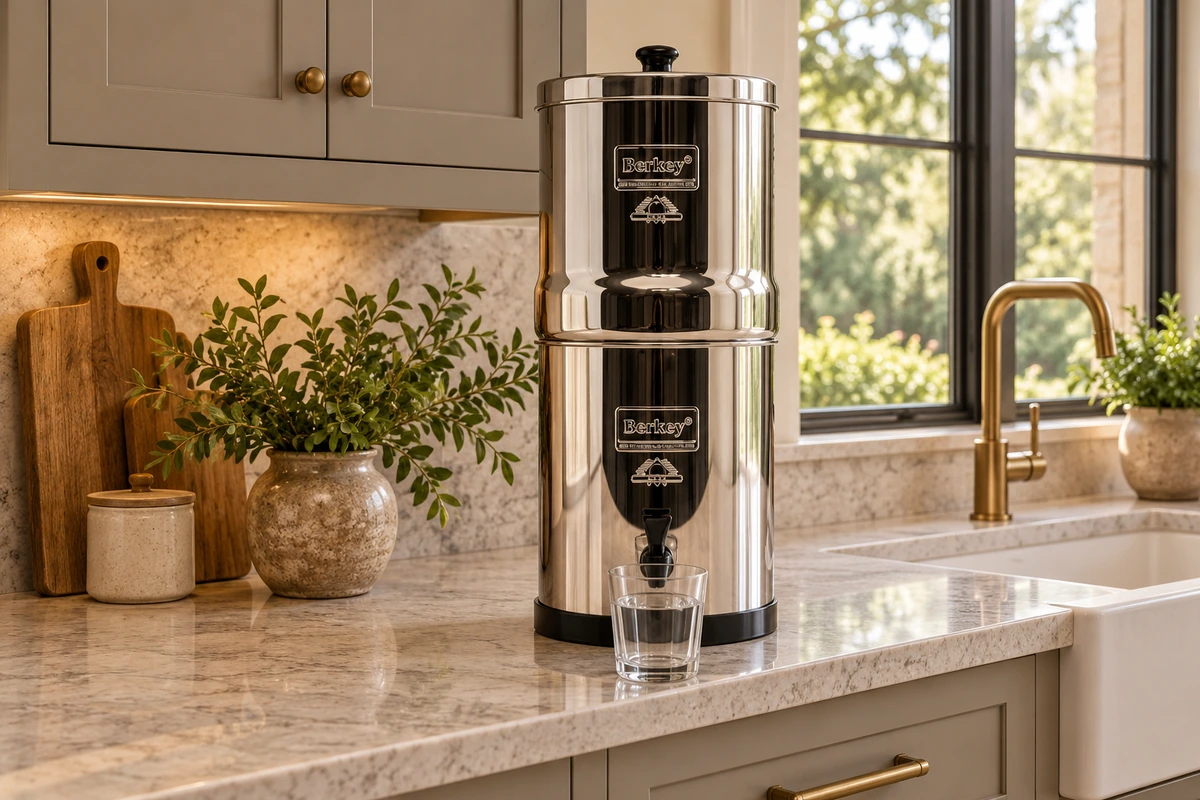
In our house, this meant changes to laundry and homemade cleaners, a Berkey water filter, and homemade skin care. The kitchen equipment changed more gradually, as money allowed. I find it more useful to name those actual changes than to present a perfect house as the starting point.
Start With the Water You Actually Have
Campbell-McBride prefers a simple carbon filter. She advises against reverse osmosis and distilled water because of her views about water’s energetic and physical structure. That is the reason given in the book; it should not be rewritten as a verified health test of “living” versus “dead” water.[1]
For a filter decision, start with your utility’s water-quality report or appropriate well testing. CDC explains that treatment methods address different contaminants. Check the exact model’s certified reduction claims, capacity, and maintenance instructions. A carbon filter does not automatically remove every chemical or germ, and another treatment method may be needed for a particular problem.[2]
We use a Berkey. That is a family-use statement, not a claim here that our filter removes a particular contaminant from your water. The model, filter elements, water source, and upkeep matter.
The book also suggests lemon, cider vinegar, vegetable-ferment liquid, or a tablespoon of kombucha in water, describing a change in its energetic pattern. These additions should not be treated as water purification or proof that unsafe water has become safe.[1][2]
What the Book Says About Dishes
The author favors hand-washing, especially near the beginning of the protocol, because she is concerned about detergent residues. Her mustard-powder example is 3 to 4 tablespoons in 2 liters of hot water, followed by a clean-water rinse. She also names vinegar and bicarbonate of soda as alternatives.[1]
There is relevant research on residues, but its scope matters. A study of dishwasher detergents and rinse aids found that residues associated with professional dishwashers could damage gut epithelial cell models. It did not show that every household dishwasher causes illness or that hand-washing leaves no residue.[4]
Keep cleaning and sanitizing separate. The book’s household suggestions are not validated disinfectant formulas. Rinse dishes carefully and follow appropriate hygiene guidance for the items you are washing. We made our own dishwasher detergent as part of our household changes; that does not turn our experience into a test of every detergent or machine.
The Cleaning Examples in the Book
| Task | The Author’s Example |
|---|---|
| General cleaning | Water, with vinegar or lemon juice, bicarbonate of soda, or olive oil mentioned as options. |
| Wood floors | Strong brewed tea. |
| Furniture polish | 1 cup olive oil with ¼ cup white vinegar. |
| Glass | Vinegar. |
| A red-wine spill on carpet | White wine applied to the spill. |
These are source examples, not one mixture to combine or a guarantee for every surface. Check the care instructions for your flooring, finish, fabric, or stone before trying an acidic or oily cleaner. A hidden-area test is more useful than assuming “natural” means compatible with every material.[1]
Laundry Was a Meaningful Change for Us
We changed our laundry detergent, stopped using fabric softener, and rewashed all clothes and sheets during the 2026 eczema flare. We also made homemade laundry detergent. Those details belong to our family’s experience; they are not proof of a particular toxin leaving the body.
The book advises minimizing fragranced laundry products. For your own review, record the detergent and any softener, scent beads, or other added product that actually touches your fabrics. Read the label rather than choosing a replacement only because its packaging says “green” or “natural.”[1]
Ventilation, Houseplants, and Renovation
Campbell-McBride recommends airing the house and avoiding unnecessary artificial fragrance. EPA also emphasizes source control and appropriate ventilation. Opening windows needs to fit the outdoor air conditions; a polluted or smoky day is not the same situation as a clear one.[1][3]
The book recommends houseplants and keeping them free of mold. Plants can be enjoyable, but a reasonable number of passive houseplants has not been shown to keep ordinary rooms toxin-free. They do not replace source control or ventilation. The book’s suggestion to use raw-meat rinse water on plants should not become a household routine; washing raw meat can spread contamination through splashes.[1][3][5]
The author advises deferring redecoration and refurnishing for at least a year while following her recovery approach. She also gives broad statements about paint and carpet emissions. Emissions vary by product and conditions; her one-year recommendation is not a test proving that every room or person is safe after that date.[1][3]
A Small Household Review
- Write down the water source and exact filter elements, if you use a filter.
- List the products used on dishes, clothes, floors, and other frequent-contact surfaces.
- Record recent painting, new furniture, carpeting, or other material changes.
- Keep surface-care instructions and any product-specific testing information.
- Choose a manageable change and note the date.
Keep the Home Plan Practical
The Low-Tox GAPS Home and the Low-Tox Home Swap Guide are listed in the shop alongside the cleaning and laundry resources.
Your Next Step
Start with one frequently used routine and write down its exact products. For items applied directly to the body, continue with the personal-care guide.
References
- Campbell-McBride, Natasha. Gut and Physiology Syndrome (2020), “Detoxification for People with Gut and Physiology Syndrome,” “1. Reduce your general toxic load”.
- Centers for Disease Control and Prevention. About Choosing Home Water Filters.
- Environmental Protection Agency. The Inside Story: A Guide to Indoor Air Quality.
- Ogulur et al.. Gut Epithelial Barrier Damage Caused by Dishwasher Detergents and Rinse Aids.
- USDA Food Safety and Inspection Service. Washing Food: Does It Promote Food Safety?.

Leave a comment