

The GAPS bath passage describes a warm bedtime bath with one of five additives, introduced gradually. It gives amounts for its general approach, but it does not give a separate baby dose, a tub volume, or a fixed schedule for increasing the strength. Those details matter when you read it for your own family.[1]
Baths were not one unchanging routine in our house. During our first six weeks on Intro, our fourth-born’s eczema was at its worst. We stopped bathing the children because their skin did better without baths. They came back after week six. That experience is why the response to a routine matters to me as well as the routine itself.
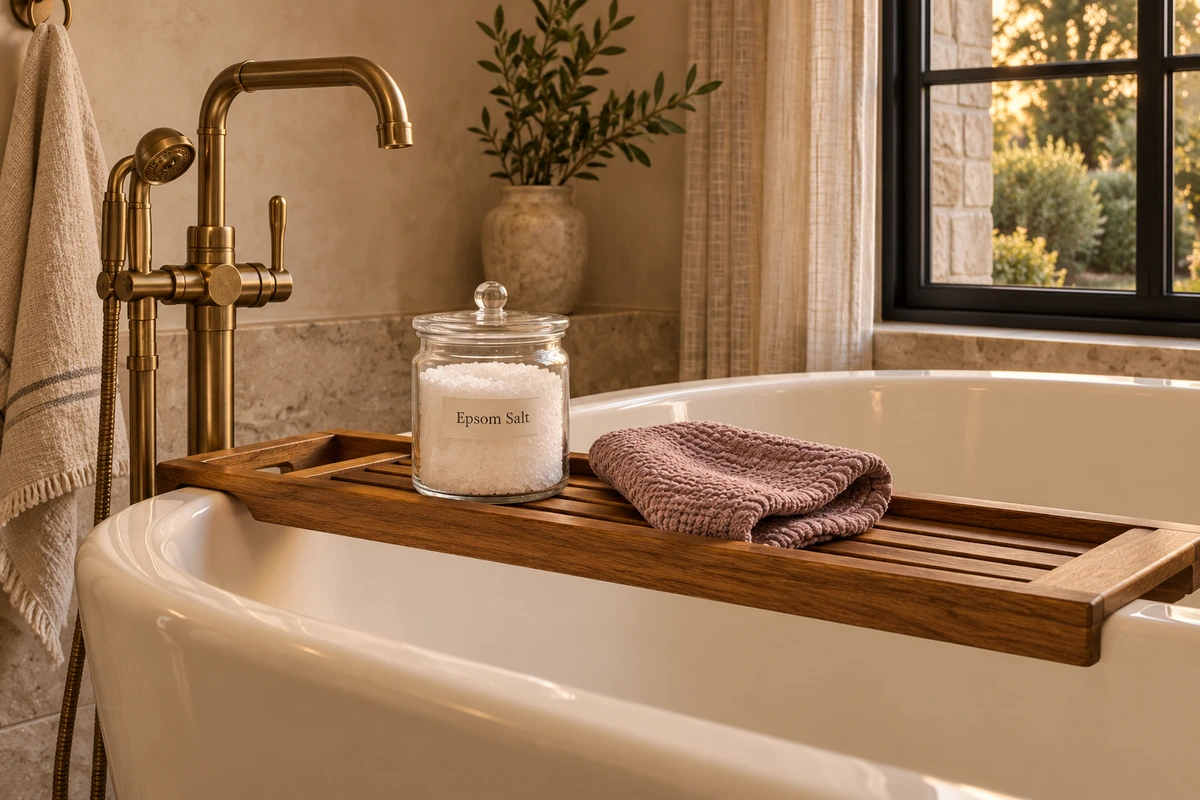
The Five Alternatives in the Book
| Additive | Amount Named in the General Passage |
|---|---|
| Epsom salt | 1 cup |
| Cider vinegar | 1 cup |
| Seaweed powder | 1 cup |
| Natural salt | 1 cup |
| Bicarbonate of soda | 1 cup |
These are five alternatives, not a five-ingredient mixture. Campbell-McBride does not rank them or give a Monday-to-Friday rotation. The cup quantities are what the passage names; because it does not state the amount of bathwater, it does not supply a precise concentration or a dose that can simply be scaled to a child.[1]
How the Author Describes Starting Slowly
For a more sensitive starting point, the book describes one tablespoon of the chosen substance, cooler water, and only a few minutes in the bath. It then describes increasing heat, concentration, and time according to the person’s response. There is no fixed number of days to reach a full cup.[1]
Read those as the author’s general instructions, not as a requirement to make each bath hotter. The passage does not establish a temperature, pediatric amount, or pregnancy-specific routine. Those questions need to be settled for the individual person rather than filled in from the word “gentle.”
What the Book Calls a Detox Reaction
Campbell-McBride describes headache, faintness, dizziness, and heart palpitations after a strong bath as a possible “detox reaction.” Those symptoms do not establish that toxins are leaving the body, or that the bath should be made stronger next time.[1]
If you feel unwell, stop the bath and get out safely. Do not push through faintness or palpitations to complete a session. Palpitations with fainting, chest pain, or difficulty breathing need urgent medical help; they should not be dismissed as evidence that a detox routine is working.[2]
Bathing in the GAPS Guidance
The chapter describes mineral-bathing traditions and connects the bedtime routine with relaxation and sleep. It also proposes toxins moving out through the skin and useful minerals moving in. The historical use of baths does not by itself measure that proposed exchange or establish a mineral dose from a home bath.[1]
How Baths Returned in Our Family
During the first six weeks, when the eczema was at its worst, we stopped bathing the children. Their skin did better without baths during that period. The children missed them, so it mattered when baths came back after week six.
We used Aalgo seaweed baths and alternated them with baths described in Gut and Psychology Syndrome and Gut and Physiology Syndrome. The seaweed baths were fun for the kids because they smelled like the ocean. The other baths were fine too.
Those six weeks without baths were part of our GAPS experience just as much as the routine we returned to afterward. Another family still needs to consider its own child and circumstances.
Keep the Bath Notes Simple
- Write down which single additive you used and its amount.
- Note roughly how much water was in the bath and how warm it felt; do not assume every tub creates the same concentration.
- Record how long the person stayed in and how their skin and comfort responded.
- Keep illness, new products, or other changes in the same notes so one event is not automatically assigned to the bath.
A short note is enough. The point is to remember what happened, not to turn every evening into a test or to keep escalating a routine that is uncomfortable.
A Place for the Whole Bath Story
The GAPS Bath Routine: Detox and Eczema Baths is listed in my shop. Its family context includes both the weeks without baths and the later routine. The Detox Bath Recipe Cards are also listed in the catalog.
Your Next Step
Read the amounts alongside the missing details before trying to turn the passage into a family schedule. For the wider household context, continue with the GAPS detoxification overview.
References
- Campbell-McBride, Natasha. Gut and Physiology Syndrome (2020), “Detoxification for People with Gut and Physiology Syndrome,” “2. Daily baths at bedtime”.
- MedlinePlus. Heart Palpitations.

Leave a comment