

Full GAPS is more than a food list. Every rule has a digestive reason: why fermented food goes on the plate at every meal, why raw fruit is eaten between meals, and why animal fat is used generously. My complete Full GAPS Diet guide covers what the diet includes and how everyday meals are built. This article stays with the mechanics behind that structure, including several rules that are easy to miss.
In our house, Full GAPS has to work around my work and our homeschool day. For a practical planning check, use the rules as four concrete questions: is fermented food included with meals, are cooked and raw vegetables both present when tolerated, are the cooking fats suitable, and is raw fruit kept separate? That keeps the reasoning connected to what needs attention in the kitchen.
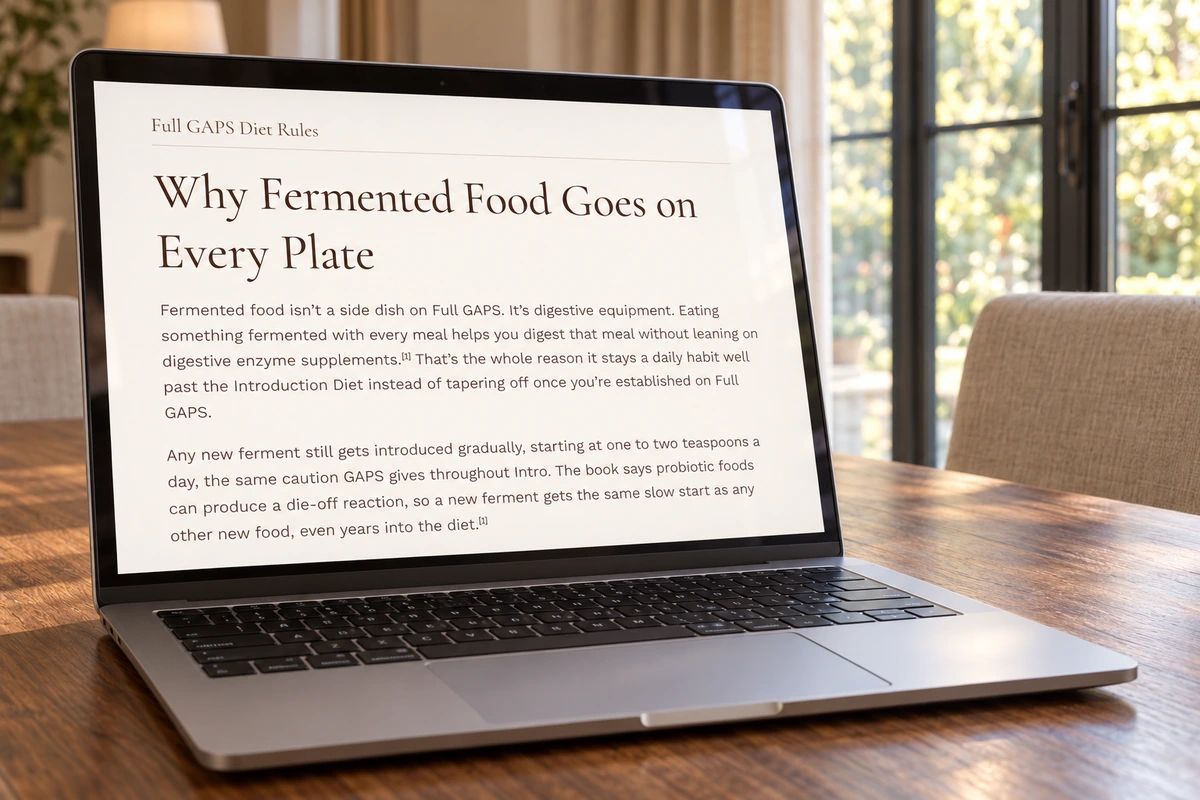
Why Fermented Food Goes on Every Plate
Dr. Natasha includes fermented food with every Full GAPS meal to help with digestion. She describes it as helping you digest the meal without supplemental digestive enzymes.[1] That is why fermented food remains part of the daily meals after Intro.
Any new ferment still gets introduced gradually, starting at one to two teaspoons a day, the same caution GAPS gives throughout Intro. The book says probiotic foods can produce a die-off reaction, so a new ferment gets the same slow start as any other new food, even years into the diet. This starting amount is for a new ferment; it does not mean restarting foods you already tolerate.[1] The book also describes a separate approach for people who are very sensitive to histamine and other biogenic amines: moving slowly through Intro, initially without fermented foods when necessary, then trying tiny amounts. My histamine and GAPS guide explains that slower introduction.[3]
Dairy ferments, butter and ghee also have their own introduction sequence. If you started Full GAPS without Intro, or could not introduce dairy during Intro, use the book’s Dairy Introduction Structure and its allergy exceptions.[5]
Why Raw and Cooked Vegetables Both Matter
Full GAPS doesn’t pick a side between raw and cooked vegetables, because they do different jobs. Cooked vegetables are gentler and easier to break down. Raw vegetables, salads and sticks, provide enzymes and detoxifying substances that help you digest the meat sitting next to them on the plate.[1] That’s a practical reason to build most Full GAPS meals with both on the plate at once, not a preference for variety’s sake.
Why Raw Fruit Is Eaten Between Meals
Raw fruit has a different digestion pattern than the rest of a Full GAPS meal, and mixing it in makes the stomach work harder than it needs to. GAPS’s guidance is to eat raw fruit on its own, as a snack between meals rather than part of one, and for most people, to avoid it altogether at the start until digestive symptoms have eased.[1] If you’re starting on Full GAPS without doing Intro first, that means keeping fruit and baking out completely for the first few weeks, then reintroducing them slowly while watching what happens. Your body will tell you if you moved too soon, because whatever improved when you avoided fruit and baking will come back if you weren’t ready.[1]
Why Animal Fat Is Used Generously
GAPS directs readers to use natural fats in every meal and states that the more animal fat you consume, the quicker you will recover.[1] Fat in a meal regulates blood sugar and controls carbohydrate cravings, and the bulk of the fat should come from animal fats rendered from meats. Butter and ghee are also named, while coconut oil is a separate stable cooking fat.
Plant oils are treated with more caution. Cold-pressed olive oil is the most stable and reliable choice, a good source of vitamin E and other antioxidants. Other cold-pressed oils, hemp, walnut, avocado, pumpkin, are fine too, but they’re fragile, easily damaged by light, heat, and oxygen, and should only be used as a dressing on food that’s already served, never heated. If an oil smells or tastes even slightly rancid, GAPS is direct that you don’t use it, no matter what it cost. Coconut oil is the plant-derived exception described as stable for cooking, while organic ghee is a separate dairy fat also used for cooking.[1]
Two Small Rules That Are Easy to Miss
Two details from this part of the book rarely make it into shorter summaries of Full GAPS. First, no microwave. GAPS’s guidance is to cook and warm food using a conventional oven and stove instead, described plainly as a way to avoid destroying food.[2] Second, there’s no universal ratio of protein-rich food to vegetables that applies to everyone at every meal. Nobody can dictate that proportion for you. Only your own body knows it, and it tells you through your own senses, which is part of why GAPS recommends keeping a food diary through Intro and beyond, so you learn to read your own signals instead of someone else’s rule of thumb.[2]
If Diarrhea Shows Up
Any of these mechanics can get thrown off by a setback. If diarrhea shows up at any point on Full GAPS, the guidance is to go back to the first or second stage of the Introduction Diet for a few days: meat stock, soups, meat and vegetable stews, fish, eggs, fermented dairy, and well-cooked vegetables, until the diarrhea fully clears. Once stools have been normal for a few days, raw vegetables come back slowly, one at a time and in small amounts, followed gradually by nuts, oily seeds, and fruit.[2]
The book deals separately with profuse watery diarrhea and temporarily excludes even well-cooked vegetables in that situation. My diarrhea guide explains that advice alongside the other food choices and care signs.[4]
Frequently Asked Questions
Why Does Fermented Food Matter So Much on Full GAPS, Not Just on Intro?
The book describes fermented food as helping you digest the meal, which is why it remains part of Full GAPS after Intro. Keep familiar ferments in the amounts you already tolerate, and give a new ferment its own small introduction rather than increasing several at once.[1]
Is It Really True That More Animal Fat Means Faster Recovery?
That’s GAPS’s own stated guidance: use generous amounts of animal fat when cooking, because the more you consume, the quicker you’ll recover.[1]
Why Can’t I Heat Plant Oils Like Walnut or Avocado Oil?
They’re fragile and easily damaged by light, heat, and oxygen. GAPS’s guidance is to use them only as a raw dressing on food that’s already been served, and to cook with coconut oil, ghee, or animal fat instead.[1]
What Should I Do If My Symptoms Come Back After Doing Well on Full GAPS?
If diarrhea returns, the book directs you back to first- or second-stage Intro foods for a few days until it completely clears. After stools have been normal for a few days, introduce raw vegetables slowly, one at a time and in small amounts. Once vegetables have been introduced, bring back nuts, oily seeds and fruit gradually.[2]
Where to Start
Pick one detail from this guide to check in your kitchen this week: is there a fermented food you already tolerate with the meal, is raw fruit kept for a separate snack, and are you cooking with a suitable fat and keeping fragile plant oils for dressing the served meal? Reviewing those three points together gives you a practical way to apply this part of the Full GAPS chapter at the next meal.
If you would like to work through the wider daily pattern with more support, my First 30 Days on Full GAPS course is listed in the WFLI shop.
References
- Campbell-McBride, N. Gut and Physiology Syndrome (2020), Chapter 14, “The Full GAPS Diet,” pages 177–178: Full GAPS staples, fermented foods, raw and cooked vegetables, fruit between meals, and fats.
- Campbell-McBride, N. Gut and Physiology Syndrome (2020), Chapter 14, “The Full GAPS Diet,” page 179: diarrhea setback route, meal proportions, microwave instruction, food diary, and duration.
- Campbell-McBride, N. Gut and Physiology Syndrome (2020), “Histamine and Other Biogenic Amines,” individual tolerance, slow Intro, and the initial fermented-food exception.
- Campbell-McBride, N. Gut and Physiology Syndrome (2020), Chapter 13, “GAPS Introduction Diet,” First Stage, probiotic-food temperature and the profuse watery diarrhea exception; Chapter 26, “Bowel Management,” “Diarrhea”.
- Campbell-McBride, N. Gut and Physiology Syndrome (2020), Chapter 14, “Dairy Introduction Structure,” its applicable starting groups, sequence and dairy-allergy exceptions.

Leave a comment