

The Full GAPS menu follows meals and drinks from waking through bedtime. My complete Full GAPS Diet guide covers the daily food foundation. This guide turns the book’s sample menu into a timeline you can adapt to the clock your household actually keeps.
The Detox Window: 4 A.M. to 10 A.M.
Every day runs through a 24-hour cycle of activity and rest, feeding and cleaning up. Dr. Natasha describes the hours from about 4 a.m. to 10 a.m. as a cleansing, or detoxification, period. Fresh fruit and vegetables, water with lemon or cider vinegar, freshly pressed juices or a GAPS shake, and probiotic foods support that process. Loading the body with other food during this window is described as interfering with it, which is part of why a lot of people simply aren’t hungry first thing in the morning.[1]
Breakfast is better placed around 10 a.m., once the body has moved from detox mode into feeding mode. The same passage says children may be hungry earlier, and sometimes adults are ready for a hearty breakfast early in the morning too. Follow your hunger rather than treating 10 a.m. as a fixed breakfast time.[1]
The Morning Glass
Start the day with a glass of still mineral or filtered water with a slice of lemon or a teaspoon of apple cider vinegar, warm or room temperature to your preference. If you have a juicer, a fresh-pressed juice can take its place. A good starting ratio is 40 percent apple, 55 percent carrot, and 5 percent beetroot, all raw. More broadly, GAPS recommends keeping juices about half therapeutic ingredients, carrot, beetroot at no more than 5 percent of the whole juice mixture, celery, cabbage, lettuce, or greens, and half tasty ones, pineapple, apple, orange, grapefruit, grapes, or mango, to soften the taste of the therapeutic half.[2]
This is also where the fresh-pressed GAPS milkshake fits when fat digestion is difficult: the same juice whisked with one to two whole raw eggs, including yolks and whites, and two tablespoons of homemade raw sour cream or coconut oil, or homemade animal fat that has been melted and cooled to room temperature, taken on a fairly empty stomach first thing in the morning and again mid-afternoon.[2]
Choose the shake and bedtime dairy options using foods you have already introduced. If you started directly on Full GAPS, or could not introduce dairy during Intro, follow the book’s Dairy Introduction Structure, including its allergy exceptions.[5]
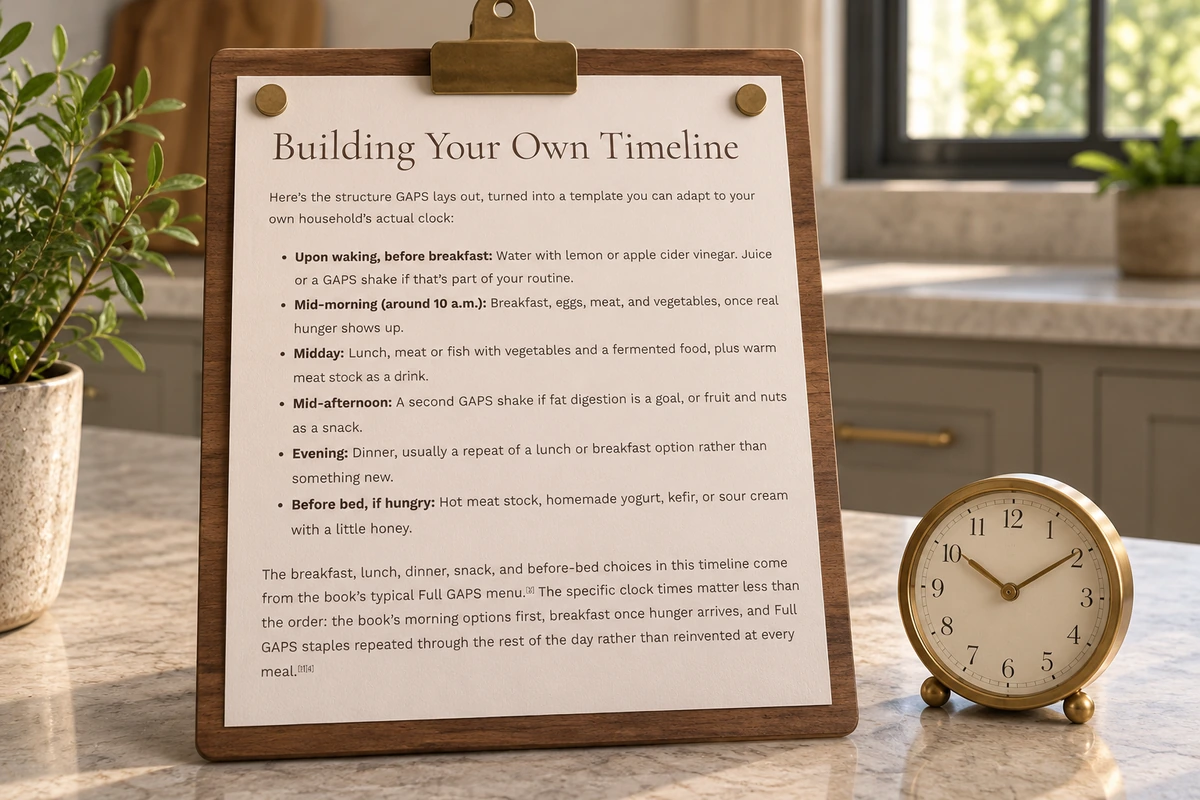
Building Your Own Timeline
Here’s the structure GAPS lays out, turned into a template you can adapt to your own household’s actual clock:
- Upon waking, before breakfast: Water with lemon or apple cider vinegar. Juice or a GAPS shake if that’s part of your routine.
- Mid-morning (around 10 a.m.): Breakfast, eggs, meat, and vegetables, once real hunger shows up.
- Midday: Lunch, meat or fish with vegetables and a fermented food, plus warm meat stock as a drink.
- Mid-afternoon: A second GAPS shake if fat digestion is a goal, or fruit and nuts as a snack.
- Evening: Dinner, usually a repeat of a lunch or breakfast option rather than something new.
- Before bed, if hungry: Hot meat stock, homemade yogurt, kefir, or sour cream with a little honey.
The breakfast, lunch, dinner, snack, and before-bed choices in this timeline come from the book’s typical Full GAPS menu.[3] The specific clock times matter less than the order: the book’s morning options first, breakfast once hunger arrives, and Full GAPS staples repeated through the rest of the day rather than reinvented at every meal.[1][4]
Fit the Menu to Your Household’s Real Clock
As a working, homeschooling mother of six, I need a meal schedule that can move with the day. The useful part of this menu is knowing what comes next, not pretending that every breakfast happens at the same minute.
Start with the fixed parts of your own day: when people wake, when breakfast is realistic, when lunch has to be ready and who will handle dinner. Keep the book’s sequence, morning water or juice, breakfast when hunger arrives, then repeated GAPS staples through the day, while moving the clock times to fit the household rather than forcing the household to fit the sample schedule.
Frequently Asked Questions
Does Breakfast Have to Wait Until 10 A.M. on Full GAPS?
No. Dr. Natasha suggests breakfast around 10 a.m. in her discussion of the daily detoxification cycle, but the same passage says children and some adults may be hungry earlier. Her instruction is to follow your hunger.[1]
What If My Kids Are Hungry Before 10 A.m.?
If a child is hungry on waking, plan an earlier breakfast from the book’s choices rather than waiting for the sample time. Other people in the household can eat when their own hunger arrives.[1]
Do I Have to Make a Fresh Juice Every Single Morning?
No. Water with lemon or apple cider vinegar is the baseline. Juice and the GAPS shake are offered as options if you have a juicer and want the additional support they provide.[2]
Is It a Problem If Dinner Is Basically the Same as Lunch?
No, that’s the intended structure. GAPS’s own guidance for dinner is simply to repeat one of the lunch or breakfast choices rather than invent something new for the evening.[3]
Where to Start
Write out your own household’s actual clock next to the timeline above, not an idealized one. Mark where breakfast realistically happens, when lunch has to be ready, and who’s cooking dinner. That real version, adjusted to your own week, is more useful than following the book’s hours exactly.
For more structure, use the two-week Full GAPS meal plan. If the morning shake is part of your plan, use the GAPS shake formula and timing in the Full GAPS guide.
For a place to organize your own week, look for my Weekly Kitchen Rhythm Planner in the WFLI shop.
References
- Campbell-McBride, N. Gut and Physiology Syndrome (2020), Chapter 14, “A Typical Menu on the Full GAPS Diet,” the daily cycle and hunger guidance.
- Campbell-McBride, N. Gut and Physiology Syndrome (2020), Chapter 14, “A Typical Menu on the Full GAPS Diet,” page 184: morning water, fresh-pressed juice, and the GAPS shake.
- Campbell-McBride, N. Gut and Physiology Syndrome (2020), Chapter 14, “A Typical Menu on the Full GAPS Diet,” sections “Breakfast Choices,” “Lunch,” and “Dinner.”
- Campbell-McBride, N. Gut and Physiology Syndrome (2020), Chapter 14, “The Full GAPS Diet,” pages 177–179: daily staples, fermented foods, natural fats, and meal balance.
- Campbell-McBride, N. Gut and Physiology Syndrome (2020), Chapter 14, “Dairy Introduction Structure,” its applicable starting groups, sequence and dairy-allergy exceptions.

Leave a comment