

The duodenum is the first section of the small intestine after the stomach. It receives acidic food from the stomach, bicarbonate and enzymes from the pancreas, and bile from the liver and gallbladder.[1] The GAPS framework places low stomach acid, failed hormone signaling, and poor enzyme and bile delivery inside its duodenum picture.[2] It also connects that picture with damaged gut flora[5] and source-described parasite activity.[8] This guide shows how those pieces fit together and where each detailed question belongs.
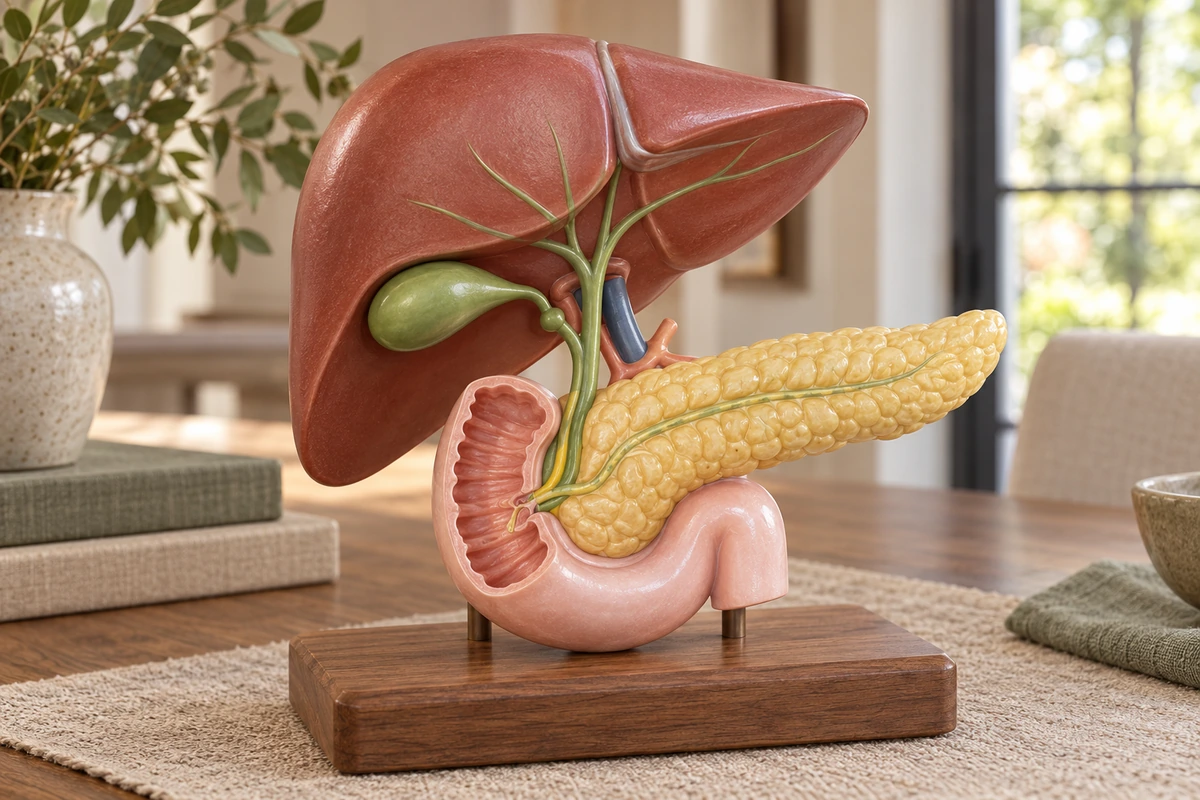
What the Duodenum Does
Food leaves the stomach through the pylorus and enters the duodenum as chyme. The duodenum continues digestion with its own mucosal enzymes and secretions, bile entering through the biliary system, and pancreatic enzymes entering through the pancreatic ducts.[1]
Two hormones help coordinate that work:
- Secretin is released from the duodenal lining in response to acid and stimulates bicarbonate-rich pancreatic fluid that helps neutralize the incoming acidity.[3]
- Cholecystokinin, or CCK, responds to fats and protein-digestion products, stimulates gallbladder contraction and pancreatic enzyme secretion, and helps deliver bile for fat digestion.[4]
This is why a problem in the stomach, pancreas, liver, gallbladder, bile ducts, intestinal wall, or microbial environment can all show up as a problem centered around the duodenum.
How GAPS Connects Low Stomach Acid
Gut and Physiology Syndrome treats stomach acidity as the first signal in a digestive sequence. In the source model, food that reaches the duodenum without enough acidity does not trigger secretin and CCK normally. Pancreatic bicarbonate and enzymes, bile flow, and protection of the duodenal lining can all be affected downstream.[2]
The duodenum mechanism guide follows that sequence through stomach acid, secretin, CCK, brush-border enzymes, pancreatic juice, bile flow, fat digestion, and the source’s parasite and nighttime-symptom context.
The Gut-Wall and Absorption Piece
The duodenum and the small intestine are major sites of digestion and nutrient absorption. The GAPS book describes enterocytes and brush-border enzymes on the intestinal surface as part of the final stages of digestion. It says abnormal gut flora can interfere with the renewal and function of that lining, while inadequate enzyme activation leaves food incompletely digested.[5]
That is the reason the GAPS route focuses on the whole digestive chain rather than treating the duodenum as an isolated tube. Stomach acid, pancreatic function, bile, food preparation, the gut wall, and gut flora all affect what happens there.
Fat, Bile, and Stool
Bile enters the duodenum to help digest and absorb fat. CCK stimulates gallbladder contraction, while secretin contributes to biliary and pancreatic bicarbonate secretion.[4][6] When that system is not working well, the larger pattern can include poor fat tolerance and loose, greasy stool.[7]
GAPS uses natural fat as part of the food route and brings it in according to tolerance. The duodenum food and support guide covers fresh meat stock, the current bone-broth timing, fermented cabbage foods, HCl and pepsin, ox bile, pancreatic enzymes, dairy, stages, and the source-defined antiparasitic boundaries.
Parasites in the GAPS Source
The GAPS A-to-Z entry on duodenum problems gives worms and flukes a prominent place. It describes some organisms moving into the duodenum at night to feed and connects that source model with disrupted sleep, belching, hot flushes, night sweats, abdominal cramps, and nightmares.[8]
That is Campbell-McBride’s explanation. Those symptoms do not prove that a parasite is present, identify a species, or authorize antiparasitic treatment. The duodenum symptoms and gut-signs guide keeps the nighttime and parasite-associated patterns clearly separated from diagnosis.
When GAPS Addresses Parasites Directly
The book’s parasite section advises healing the gut first, generally for at least six months and preferably closer to a year, before directly addressing chronic worms and parasites. Its reason is that die-off adds toxicity and inflammation, while changes in the gut environment may reduce the imbalance without a separate protocol.[9]
The detailed medication-versus-herbal discussion belongs in the food and support guide because the source attaches timing, duration, supervision, and condition-specific limits to that decision. This overview does not supply an antiparasitic dose or schedule.
The GAPS Food and Support Overview
The practical GAPS route begins with the digestive system:
- use fresh meat stock during the early protocol and wait at least one year before bone broth, longer for some people;[10]
- follow the Introduction Diet when deeper digestive healing is needed;
- use fermented cabbage foods and cabbage juice in the source’s stomach-acid support;
- introduce natural fat according to digestive tolerance;
- use temporary digestive support only inside its stated quantity, timing, and stopping limits.
Rachael Mamane’s Mastering Stocks and Broths controls stock-making technique, while the current GAPS book controls when meat stock and bone broth belong in the protocol.[11]
Continue Through the Duodenum Guides
- What Causes Duodenum Problems in the GAPS Framework explains the acid, hormone, enzyme, pancreas, bile, fat, and parasite mechanisms.
- GAPS Diet for Duodenum Problems: Foods and Support contains the implementation details and source limits.
- Duodenum Problems Symptoms and Gut Signs organizes the digestive, stool, nutritional, nighttime, and parasite-associated signs without diagnosing from a checklist.
The 90-Day Family Food Diary helps keep meals, supplements, stool patterns, fat tolerance, sleep, stress, and nighttime symptoms together.
Frequently Asked Questions
Does Duodenum Pain Prove a Parasite?
No. The GAPS material also discusses low stomach acid, pancreatic and brush-border enzymes, bile flow, and fat digestion. A symptom pattern alone does not prove a parasite or one duodenal diagnosis.
Why Does GAPS Use Fat?
Fat and protein stimulate CCK, which promotes gallbladder contraction and pancreatic enzyme secretion.[4] GAPS therefore introduces natural fat according to tolerance rather than making long-term fat restriction the goal.
Is Betaine HCl Permanent?
No. The GAPS sources describe it as temporary support while natural acid production recovers and warn that long-term HCl and pepsin can irritate the stomach.[12]
References
- Omole, A. E., S. Gogna, and A. Khorasani-Zadeh. “Anatomy, Abdomen and Pelvis: Duodenum.” StatPearls, updated January 31, 2026.
- Campbell-McBride, N. Gut and Physiology Syndrome (2020), “Digestive Enzymes,” pp. 338–340.
- DiGregorio, N., and S. Sharma. “Physiology, Secretin.” StatPearls, 2023.
- Okonkwo, O., D. Zezoff, and A. Adeyinka. “Biochemistry, Cholecystokinin.” StatPearls, updated May 1, 2023.
- Campbell-McBride, N. Gut and Physiology Syndrome (2020), pp. 123–126; “Pancreatic problems,” p. 442.
- Dave, H. D., K. R. Shumway, and N. M. Al Obaidi. “Physiology, Biliary.” StatPearls.
- National Institute of Diabetes and Digestive and Kidney Diseases. “Symptoms and Causes for Exocrine Pancreatic Insufficiency.” Accessed October 7, 2026.
- Campbell-McBride, N. Gut and Physiology Syndrome (2020), “Duodenum problems,” pp. 419–420.
- Campbell-McBride, N. Gut and Physiology Syndrome (2020), “Parasites and worms,” pp. 447–448.
- Campbell-McBride, N. Gut and Physiology Syndrome (2020), “Meat stock and bone broth,” p. 223.
- Mamane, R. Mastering Stocks and Broths, Part Two, chapters 8 and 9.
- Campbell-McBride, N. “Stomach,” Q2, and “Supplements,” Q13, GAPS FAQs.

Leave a comment