

If you want to understand GAPS rather than collect more food rules, I recommend beginning with Dr. Natasha Campbell-McBride’s Gut and Physiology Syndrome and reading it alongside Gut and Psychology Syndrome. The first explains the wider physical-health picture and her updated nutritional protocol. The second develops the gut-brain explanation that began GAPS. Together, they give the cooking, supplements, and home changes a reason and a purpose.[1][2]
I have read and studied both books while running GAPS with my family. I also use all the books from the original GAPS coaching kit. Some help explain the program, some take one subject further, and others help with the practical work. Here is what each contributes and how I would choose among them.
In our house, speech concerns led me to gut health research first, and eczema brought me back to it later. I’ve written out the full order of events in our story. That experience is part of why I value having both the brain-focused book and the physical-health companion. Our questions did not stay neatly inside one subject.
How the GAPS Books Fit Together
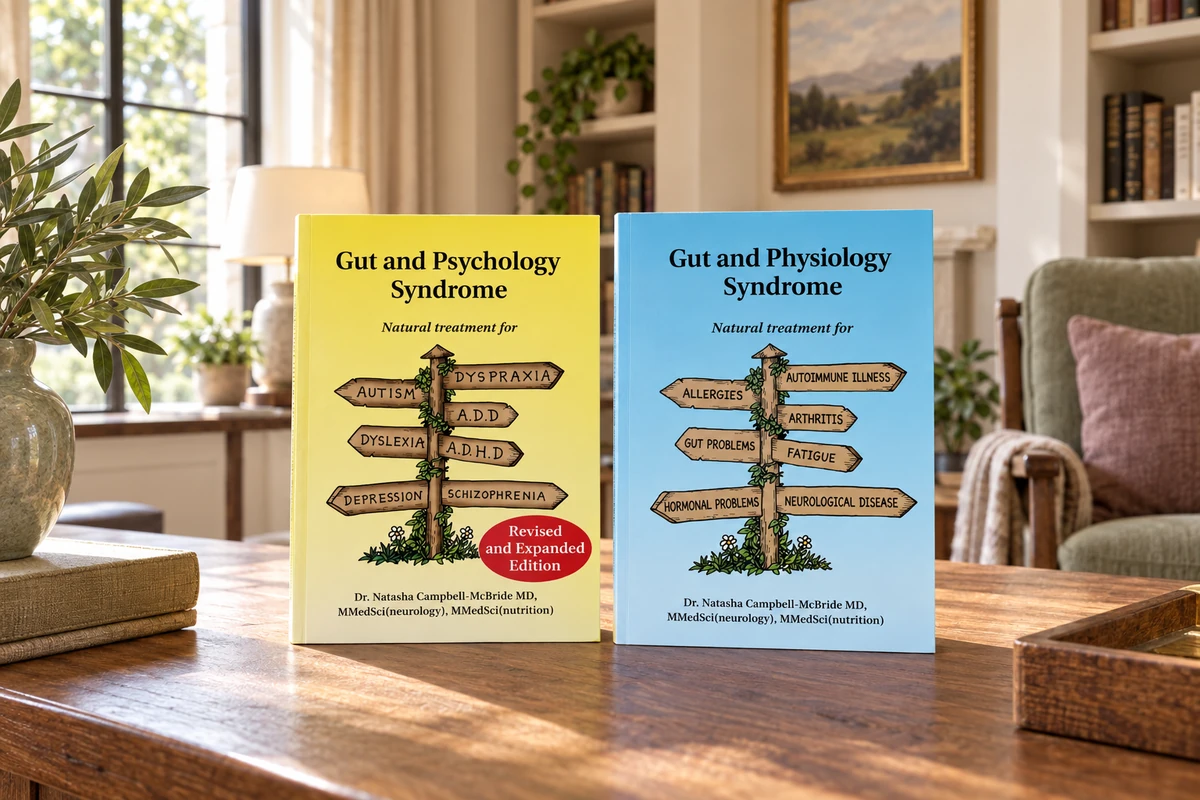
The current GAPS Training Certification Book Kit brings together six books and one journal. It includes work by Dr. Natasha, Monica Corrado, and Amy Mihaly, as well as the contributors to GAPS Stories. The two core program books are pictured below; the table includes all seven kit items.[3]
| Title | Its Main Contribution | When I Would Reach for It |
|---|---|---|
| Gut and Physiology Syndrome | The connection between gut health and the rest of the body, followed by the updated GAPS program. | You want to understand the program as a whole or arrived through a physical-health concern. |
| Gut and Psychology Syndrome | The original gut-brain explanation, with practical food guidance and family topics. | You want the reasoning behind GAPS and a closer look at learning, behavior, and feeding. |
| Put Your Heart in Your Mouth | Dr. Natasha’s argument about cholesterol, animal fats, food, and cardiovascular health. | You want to understand her position on fats beyond the GAPS food list. |
| Vegetarianism Explained | Her examination of how animal and plant foods serve the body. | You want to understand her reasoning about food choices and plant-based eating. |
| GAPS Stories | Personal accounts from people who followed the nutritional protocol. | You want to hear how other people experienced the work and the changes. |
| The Complete Cooking Techniques for the GAPS Diet | Monica Corrado’s detailed teaching on essential GAPS kitchen methods. | You understand the food guidance but need help carrying it out. |
| My Daily Insights: A GAPS Journal | Amy Mihaly’s place to record meals, symptoms, daily tasks, and weekly observations. | You want your own dated observations together rather than relying on memory. |
Gut and Physiology Syndrome
My first recommendation for understanding the current GAPS program. This is a separate companion to the original book, not a renamed edition. Dr. Natasha begins with a question that makes its purpose clear: why separate the brain, digestion, skin, immune system, and other body systems when they affect one another? She explains that the physical symptoms she saw alongside learning and mental-health difficulties led her to write this wider account.[1]
What makes the book valuable is the connection between explanation and action. The early chapters build her picture of the gut as a living microbial community. She then follows that picture into subjects such as immunity, hormones, the liver, lungs, bones, and teeth. By the time the practical program begins, the food guidance has a larger context. You can understand why she discusses nourishment, gut flora, and the home environment together.
Her opening comparison between the gut’s microbial community and living soil is a good example of how she teaches. It gives you a familiar way to picture a complicated subject before she introduces more detailed terms. The point is not to memorize every microorganism. It is to understand why she places so much importance on the community as a whole, rather than treating GAPS as a list of foods to remove.[1]
The practical sections cover diet, supplementation, and detoxification and lifestyle changes. Within the diet, she distinguishes Intro and Full GAPS from No-Plant GAPS, Ketogenic GAPS, More-Plant GAPS, and liquid fasting. Coming off the diet also has its own discussion. That breadth is especially useful when an online summary has left you thinking there is only one way to follow GAPS.[1]
This is a substantial read. If you only want tonight’s dinner, a recipe collection will get you there faster. Its value is in helping you understand the decisions behind the meals, and giving you a reference to return to as your questions change. I would read the explanation and the program together, then use the alphabetical condition section to find a particular topic. Reading only an isolated condition entry would miss much of what the book is trying to teach.
Find Gut and Physiology Syndrome in my Amazon book collection.
For more detail, read my review of Gut and Physiology Syndrome.
Gut and Psychology Syndrome
Worth reading alongside the newer book for the original gut-brain explanation. The title can make it sound relevant only to the conditions printed on the cover. The book itself is broader: Dr. Natasha begins by describing the overlapping digestive, learning, behavioral, and physical problems she encountered in her practice. That overlap is the question she wants the reader to understand.[2]
One useful part of its teaching is the way it examines other dietary approaches before setting out GAPS. For example, the nutrition discussion explains why replacing a gluten-containing processed food with a gluten-free processed food does not accomplish what she intends for the gut. The reader gets the reasoning behind the food choices, rather than being left with a label to look for on a package.[2]
That is a meaningful strength for someone trying to make ordinary kitchen decisions. A food list can tell you that an ingredient is excluded. This book spends time explaining the author’s view of digestion, carbohydrates, proteins, fats, and gut flora, so the list connects with the rest of the program.
The expanded book also goes beyond explaining the gut-brain connection. It contains dietary guidance and recipes, feeding difficulties, failure to thrive, supplements, detoxification, and a section on a new baby in a GAPS family. The feeding chapter, for example, considers sensory experience and the mouth as well as a child’s limited range of accepted foods. That wider view helps explain why the book is not simply a cookbook or a general account of brain health.[2]
I would not choose between the two core books as though one made the other unnecessary. I use the 2020 Gut and Physiology Syndrome when their program instructions differ, while keeping the original book’s compatible explanations and additional subjects. If your immediate question is choosing a starting point, my Intro versus Full GAPS comparison can help you connect that reading with the decision in front of you.
Find Gut and Psychology Syndrome in my Amazon book collection.
Read my separate Gut and Psychology Syndrome review for a closer look at that book.
Put Your Heart in Your Mouth
This is the focused companion for understanding Dr. Natasha’s position on cholesterol, animal fats, and cardiovascular health. It takes the food-and-fat discussion further than a GAPS stage guide needs to. The central question is how she understands disease in the arterial wall and the dietary changes she proposes in response.[4]
That makes it useful when your question has shifted from “Is this food included?” to “Why does she recommend these fats?” The book argues against treating cholesterol itself as the enemy and discusses traditional foods, processed foods, and environmental exposures. It also includes recipes, so its subject is connected with eating rather than left entirely as an argument about nutrition.[4]
I would choose it for that focused explanation after establishing the core GAPS framework. It does a different job from teaching the Intro stages, and it is not the volume I would use to decide when a food belongs in the program.
Find Put Your Heart in Your Mouth in my Amazon book collection.
Read my Put Your Heart in Your Mouth review for a closer look at how Dr. Natasha explains her food-and-fat argument.
Vegetarianism Explained
The subject here is the role of animal and plant foods in human nourishment. Dr. Natasha examines how they are digested and used, then connects those questions with food production, fasting, and feeding children. It is a book about the reasoning behind food choices, not a vegetarian version of the GAPS Diet.[5]
Its place on this shelf makes sense because GAPS can raise questions that go beyond one day’s meals. Why are animal foods emphasized? What does the author mean when she distinguishes the roles of different foods? How do those choices connect with the way food is produced? This is the title devoted to that discussion. If those are the questions you want to explore, it is more directly focused on them than either program manual.
Keep its purpose distinct from More-Plant GAPS. That approach is explained in Gut and Physiology Syndrome; the words “plant” and “vegetarian” do not make the two interchangeable.
Find Vegetarianism Explained in my Amazon book collection.
Read my Vegetarianism Explained review for a closer look at how Dr. Natasha explains nourishment, digestion and food production.
GAPS Stories
GAPS Stories brings together personal accounts from people who followed the nutritional protocol. The contributors tell their own stories; the publisher credits Medinform Publishing as editor. Dr. Natasha’s work connects the collection, but these are not all accounts written by her.[6]
The contribution is different from a diet chart. A personal account can describe the work of changing food, the difficulties along the way, and the changes someone noticed in the middle of ordinary life. That is useful reading when you understand the instructions but want a better sense of what living with them can involve.
I understand the pull of that kind of reading. Our first six weeks were much harder than I expected going in, based on everything I’d read beforehand. That difficult start is as much a part of our story as the improvements that came later. Even within our own household, people didn’t respond the same way or on the same timeline.
For me, that is the reason to read this collection beside the program books. The accounts add human experience; the program books provide the instructions. Someone else’s sequence of changes can be encouraging without becoming a deadline for your family.
Find GAPS Stories in my Amazon book collection.
Read my GAPS Stories review for a closer look at the opening family account and what personal experiences add to the program books.
The Complete Cooking Techniques for the GAPS Diet
The practical companion I would choose when the kitchen method is the missing piece. Monica Corrado brings together her teaching on stock and broth, cultured dairy, lacto-fermentation, and the preparation of nuts, seeds, beans, and grains. The second edition adds ingredient and equipment guidance before the main teaching, as well as an index to help you find a particular subject.[7]
What makes it useful is the movement from an explanation into a technique and then into recipes and questions. The cultured-dairy section illustrates that approach: it explains milk and cream, why they are cultured, choices about milk, and the introduction of dairy before moving into the preparations. That sequence is helpful when “make yogurt” leaves you with several unanswered questions before you have even started.[7]
I would use this book when you know what you are trying to make but need to understand the process. A new dinner recipe does not necessarily teach you why a preparation is done in a particular order. A technique reference gives that underlying method more room.
It also looks beyond Intro and Full GAPS. Its grain work belongs to the later transition, not to the Intro or Full GAPS food list. I keep the newer program book beside technique references when checking phase and timing. For the detailed fermentation and stock methods I use on WFLI, Katz and Mamane have the technique roles described below.
Read my full review of The Complete Cooking Techniques for the GAPS Diet. You can also find Corrado’s second edition at the official GAPS shop.
My Daily Insights: A GAPS Journal
Amy Mihaly’s journal adds something the explanatory books cannot do for you: a place for your own dated observations. The daily pages bring together symptoms, food intake, completed tasks, and a moment of encouragement. A weekly check-in gives you space to review progress and observations over a longer stretch. It is undated, so you fill in the dates when you begin.[8]
The useful distinction is between remembering how a week felt and having the day’s details together. Meals, symptoms, and what you actually did can be hard to reconstruct afterward. The daily record and weekly review serve different purposes: one captures the detail, while the other gives you a chance to look back across it.
I would choose this companion if you want an established place to keep those notes while reading and applying the program. It supports observation rather than supplying another set of GAPS instructions. Its usefulness will come from returning to it consistently, including on the ordinary days when there is no dramatic change to write about.
Find Amy Mihaly’s My Daily Insights in my Amazon book collection.
Read my My Daily Insights journal review for a closer look at its daily page, weekly review and practical use.
Cookbooks and Technique Books Beyond the Kit
Once you understand the program, a cookbook can help turn a small rotation into more varied meals. The Heal Your Gut Cookbook, by Hilary Boynton and Mary G. Brackett, and Internal Bliss are recipe collections with that practical purpose. They are different from a volume devoted to explaining the GAPS framework. Choose an individual recipe for the foods and preparations you have already introduced.[14][15]
I turn to Sandor Ellix Katz’s The Art of Fermentation for fermentation technique, Rachael Mamane’s Mastering Stocks and Broths for culinary meat-stock and broth technique, and Nourishing Broth for broader traditional-broth context.[11][12][13] These references can make the kitchen work more understandable, while the GAPS program books determine the food’s place and timing in GAPS. In the 2020 book, meat stock comes first for at least the first year, and for some people several years, before bone broth is introduced.[1]
You can find the books already listed in my Amazon GAPS book collection. A recipe collection is useful for more meal ideas. A technique reference is the better choice when you need a clearer understanding of how a preparation works.
For a broader traditional-food kitchen reference, read my Nourishing Traditions review, which looks at its connected preparations, meal range, and advance planning.
More by Dr. Natasha
Her wider bibliography also includes Don’t Be a Vegetarian!, which her shop presents as a retitled Vegetarianism Explained, and Bacon in a Bathtub, about working with nature to produce food and restore land. They extend the food-choice and food-production subjects beyond the coaching-kit shelf. They are additional titles beyond the seven items in the training kit.[9][10]
Where I Would Begin
For understanding GAPS, my recommendation is to begin with Gut and Physiology Syndrome and make room for Gut and Psychology Syndrome alongside it. Read the explanation before trying to turn the food lists into a whole week of meals. Then choose the companion that solves your next real problem: a kitchen method, a focused food question, or keeping your observations together.
When you are ready to connect the reading with your own starting point, use my Intro versus Full GAPS comparison. It will help you see what changes on the plate and what each approach asks of your kitchen.
References
- Campbell-McBride, N. Gut and Physiology Syndrome. Medinform Publishing, 2020. Introduction; “Good Health Begins in the Soil Inside Us!”; “Treatment”; “GAPS Diet”; “Meat Stock and Soups.” Official book page.
- Campbell-McBride, N. Gut and Psychology Syndrome, expanded edition. Introduction; Part 1; Part 2, nutrition and feeding chapters; Part 4. Official book page.
- GAPS Diet. GAPS Training Certification Book Kit: contents and author credits.
- Campbell-McBride, N. Put Your Heart in Your Mouth. Medinform Publishing. Publisher’s description.
- Campbell-McBride, N. Vegetarianism Explained. Medinform Publishing. Publisher’s description.
- Medinform Publishing, editor. GAPS Stories: Personal Accounts of Improvement and Recovery Through the GAPS Nutritional Protocol.
- Corrado, M. The Complete Cooking Techniques for the GAPS Diet, second edition. Selene River Press, 2022. Introduction; “Before You Begin”; “Culturing Dairy”; transition section. Official book page.
- Mihaly, A. My Daily Insights: A GAPS Journal. Official description of daily and weekly pages.
- Dr. Natasha Shop. Don’t Be a Vegetarian!, formerly Vegetarianism Explained.
- Campbell-McBride, N. Bacon in a Bathtub. Medinform Publishing. Publisher’s description.
- Katz, S. E. The Art of Fermentation. Chelsea Green Publishing. Fermentation technique reference.
- Mamane, R. Mastering Stocks and Broths. Chelsea Green Publishing. Culinary stock and broth technique reference.
- Fallon Morell, S., and Daniel, K. T. Nourishing Broth. Traditional broth context and cookery.
- Boynton, H., and Brackett, M. G. The Heal Your Gut Cookbook. Chelsea Green Publishing.
- International Nutrition. Internal Bliss. GAPS cookbook.

Leave a comment