

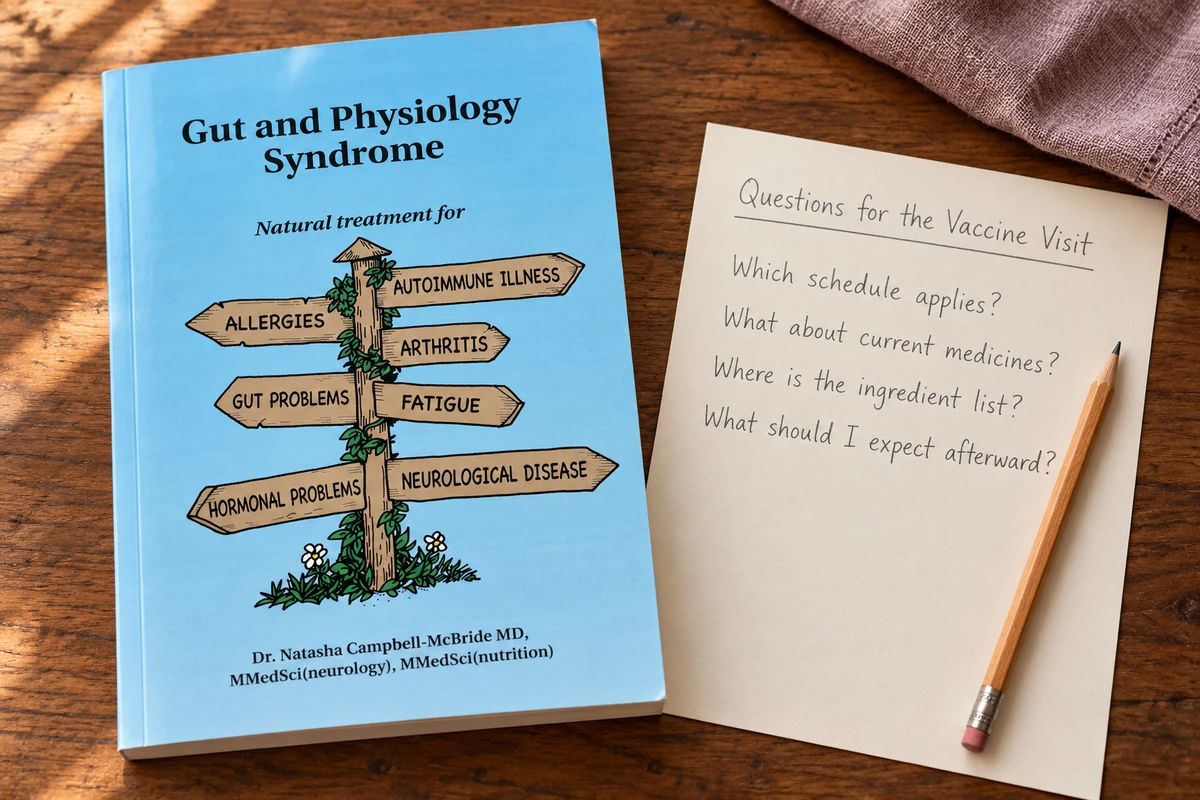
The GAPS books give two connected parts of Dr. Natasha Campbell-McBride’s vaccination approach. The expanded Gut and Psychology Syndrome book says that babies in GAPS families should not be vaccinated until they are 3 to 5 years old and have developed a strong immune system, good physical competence and the ability to communicate verbally. Gut and Physiology Syndrome adds her current instructions for a vaccination that must happen: be absolutely healthy and well, use single vaccines and space them as widely as possible.[1][3]
If you have read both books and wondered how their passages fit together, this guide puts them side by side. It separates the age statement in the expanded first book from the preparation advice in the 2020 book.
These are Campbell-McBride’s recommendations, not the routine childhood immunization schedule. Delaying recommended vaccines leaves children vulnerable to preventable infections. Discuss the book’s advice with your child’s clinician before changing vaccination timing; age 3 to 5 and verbal communication are not general requirements for beginning childhood vaccination.[4]
The Three Markers Behind Age 3 to 5
| Marker | What the Passage Says |
|---|---|
| Immune development | The child has developed a strong immune system. |
| Physical development | The child has good physical competence. |
| Communication | The child can communicate verbally. |
Campbell-McBride follows those three markers with the sentence that translates them into the 3-to-5-year age range. The age and the markers belong together. A third birthday by itself does not replace the developmental description in the paragraph.[1]
The exact age range comes from the expanded first GAPS book’s New Baby chapter. The 2020 book does not repeat that number in its vaccination-preparation section. It adds more detail about the condition of the child, nutrition, single vaccines and spacing when vaccination is required.[3]
What “Absolutely Healthy and Well” Means in the 2020 Book
The 2020 book explains what Campbell-McBride means by “absolutely healthy and well.” Campbell-McBride names no cold, runny nose or inflammation anywhere in the body, no medications, no particular stress or strain and no sleep deprivation. She also says there should be no nutritional deficiencies, especially in animal protein, animal fat and the fat-soluble vitamins A, D, E and K.[3]
For the period before and after vaccination, she directs the reader to eat plenty of high-fat animal foods, including gelatinous meat stock. Those are the source’s preparation details. They are not a replacement for the age range or the three markers in the earlier Baby GAPS passage.[3]
The same passage says babies should be breastfed during vaccination and directs families who cannot breastfeed to its wet-nursing discussion. That is another part of the author’s preparation advice.[3]
For an actual appointment, a mild cold or antibiotics for a mild illness usually do not require postponing vaccination. Do not stop prescribed medication to meet the book’s preparation list; ask the prescribing clinician about the particular medicine and vaccine.[5]
Breastfeeding can help comfort a baby during vaccination, but it is not a requirement for receiving vaccines. CDC also describes comforting alternatives, including feeding expressed breast milk or formula.[7]
Single Vaccines, Ingredients, and Spacing
The Books’ Preference for Single Vaccines
The Baby GAPS passage says to try to avoid combination vaccines and look for single vaccines. The 2020 book states the point more strongly: Campbell-McBride tells the reader to insist on single vaccines rather than several infections combined in one injection.[1][3]
The books’ preference should not be read as a finding that licensed combination vaccines are unsafe. CDC describes combination vaccines as carefully tested products that protect against several diseases with fewer injections.[6]
Request the Full Ingredient List
The expanded first book says to ask for the vaccine’s ingredient list and ask for those ingredients to be explained. Keep that question with the exact product being considered rather than relying on a general vaccine name.[1]
How the Books Describe Spacing
The 2020 book says to space vaccinations as widely as possible so the body has time to recover and the family can observe what changes after the previous vaccination. It specifically asks parents to watch whether a young child’s development, eye contact, eating, growth and overall appearance continue normally.[3]
The expanded first book gives one more precise number inside its separate assessment framework. In the route where testing shows no immune deficiency and individual vaccines are considered, it says the interval between those single vaccines should be at least six weeks. That six-week statement belongs to that specific assessment route, while the current book’s broader instruction is to space vaccinations as widely as possible.[2]
Keep the Other Vaccination Questions Separate
The age range does not contain the whole GAPS vaccination chapter. Baby GAPS Beyond Food places vaccination timing beside the book’s skin, bath, bedding and household guidance. The expanded first book discusses a family-health questionnaire, stool and urine analysis, and an infant immune-status test in its separate assessment proposal.
The older book also discusses MMR and autism. That argument is outside this article’s focus on what the books say about timing and preparation; it is not presented here as an established causal link.
Questions to Bring to an Appointment
If you are comparing these passages before an appointment, use this list to organize questions for your child’s clinician:
- The child’s age and the three developmental markers.
- Any cold, runny nose, inflammation, medication, stress, strain or sleep loss.
- The nutrition points named in the 2020 book.
- The full ingredient list for the exact product under discussion.
- Whether the product is a single or combination vaccine.
- The date of the previous vaccination and the interval being considered.
- The child’s development, eye contact, eating, growth and general appearance since the previous vaccination.
Keeping your questions together can make the appointment easier to follow. Your child’s clinician can explain the recommended schedule, any actual contraindications, and which details apply to your child.
How I Read These Passages
Here, I have kept the two book passages alongside each other so their differences are easier to see. I want you to know which book contains each statement and to have the wording in front of you when you ask questions. I am sharing a reading of the books, not a vaccination history or outcome from our family.
Keep Your Questions Together
The Care Team Log is a place to keep appointment questions, answers, and follow-up notes together. You can find it in my printable catalog.
Frequently Asked Questions
Does Turning Three Automatically Meet the GAPS Timing?
The passage gives 3 to 5 years as the age range after naming a strong immune system, good physical competence and verbal communication. It then says the child should be completely healthy and doing well at the time of vaccination.[1]
Does the 2020 Book Repeat the Age 3-to-5 Number?
The exact 3-to-5-year statement is in the expanded first book’s New Baby chapter. The 2020 book adds the current health, nutrition, single-vaccine and spacing instructions for a vaccination that must happen.[1][3]
What Spacing Do the Books Name?
The 2020 book says to space vaccinations as widely as possible. The expanded first book’s specific testing route says at least six weeks between individual vaccines when testing shows no immune deficiency and those vaccines are being considered.[2][3]
What Does the Current Book Say to Watch Afterward?
It names development, eye contact, eating, growth and whether the child continues to look well. Campbell-McBride gives that observation list as one reason to leave wide spacing between vaccinations.[3]
Your Next Step
Bring your child’s vaccination record and the questions you want answered to their clinician. If you want to discuss a GAPS passage, note its book and section so you can review the actual wording together. Keep the recommended schedule and any individualized medical advice clear before making changes.
References
- Campbell-McBride, Natasha. GAPS: Gut and Psychology Syndrome, expanded edition (2013), “New Baby,” vaccination timing and preparation paragraph. Verified against the supplied second German edition (2015).
- Campbell-McBride, Natasha. GAPS: Gut and Psychology Syndrome, expanded edition (2013), vaccination assessment framework and individual-vaccine spacing. Verified against the supplied second German edition (2015).
- Campbell-McBride, Natasha. Gut and Physiology Syndrome (2020), vaccination preparation, single-vaccine, spacing and observation instructions.
- Centers for Disease Control and Prevention. About Vaccines for Your Children.
- Centers for Disease Control and Prevention. Vaccines When Your Child Is Sick.
- Centers for Disease Control and Prevention. Combination Vaccines.
- Centers for Disease Control and Prevention. Pink Book, Chapter 6: Vaccine Administration, comforting techniques.

Leave a comment