

GAPS is not one single food list. In Gut and Physiology Syndrome, Dr. Natasha Campbell-McBride describes six GAPS dietary paths: the GAPS Introduction Diet, Full GAPS, No-Plant GAPS, GAPS Ketogenic Diet, More-Plant GAPS, and GAPS Liquid Fasting. They all belong to the GAPS Nutritional Protocol, but they change different parts of the food, preparation, or meal structure.[1][2]
This page compares what each approach changes in one place. It does not supply implementation ratios, fasting instructions, or an individual eligibility decision. Start with the GAPS basics or Intro GAPS vs. Full GAPS if those foundations are still new.
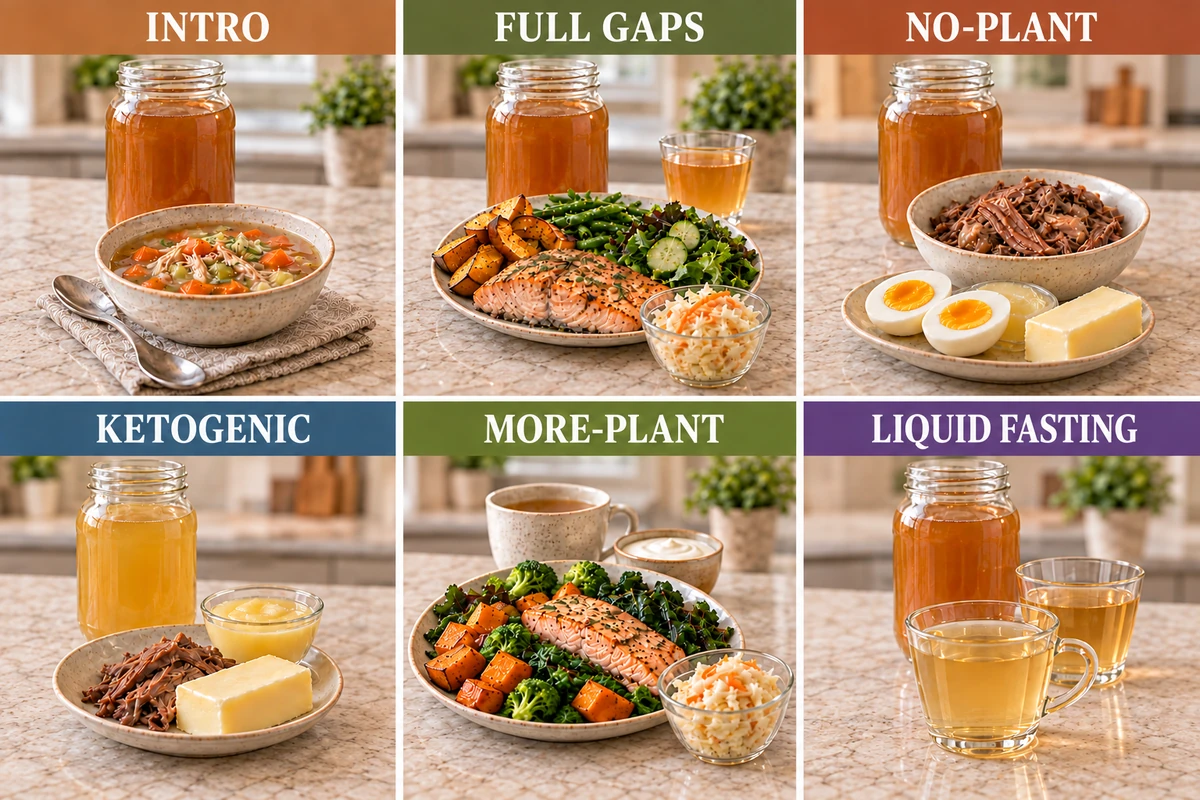
The Six GAPS Dietary Approaches Compared
| Approach | What Changes | Relationship to GAPS |
|---|---|---|
| GAPS Introduction Diet | Moves through six stages, beginning with the easiest foods to digest and adding foods and preparation methods gradually | Official staged GAPS approach |
| Full GAPS | Uses the wider GAPS food list and preparation rules as the main long-term dietary foundation | Official GAPS approach |
| No-Plant GAPS | Removes all plant matter and centers meat stock, gelatinous meats (skin, cartilage, ligaments and other collagen-rich connective tissues), organ meats, fish, shellfish, eggs, animal fats, and fermented dairy when tolerated | Official specialized GAPS approach |
| GAPS Ketogenic Diet | Begins from No-Plant GAPS, then reduces protein and carbohydrate while increasing fat to reach physiological ketosis, a metabolic state in which the body uses fat and the resulting ketones as its main energy source | Official specialized GAPS approach |
| More-Plant GAPS | Raises the proportion of well-tolerated plants while retaining meat, fish, eggs, fermented dairy, meat stock, and fermented foods | Official specialized GAPS approach |
| GAPS Liquid Fasting | Temporarily removes solid food and uses the clear liquids named by the GAPS source | Official specialized GAPS approach |
Keep the baseline food rules beside the comparison. Get the Intro and Full GAPS Food List before you compare a specialized approach with standard GAPS.
GAPS Introduction Diet
The GAPS Introduction Diet moves through six stages. It begins with homemade meat stock, soups, well-cooked meats or fish, and suitable well-cooked vegetables, then adds foods and preparation methods gradually. The stages are a sequence rather than a six-day or six-week schedule; progression follows the source instructions and the person’s response.[1]
Intro is the narrower, staged route within GAPS. It is also the path the 2020 book uses when returning to solid food after GAPS Liquid Fasting.[1]
Full GAPS
Full GAPS uses the wider GAPS food list and more cooking methods while keeping the protocol’s central foods and preparation rules. It includes meat and fish, eggs, vegetables, fermented foods, suitable fruit, properly prepared nuts and oily seeds, and specific cultured dairy foods when tolerated.[1][2]
Full GAPS is the main long-term foundation, not the same thing as finishing GAPS. The 2020 book says most people follow the strict GAPS Diet for at least two years and have at least six months of normal digestion before beginning the separate process of coming off the diet.[1]
If you start directly with Full GAPS, keep fruit and baking out for the first few weeks. Then introduce them slowly while watching symptoms. Dairy that was not introduced during Intro follows the book’s Dairy Introduction Structure rather than entering all at once.[1]
No-Plant GAPS
No-Plant GAPS removes all plant matter. The 2020 GAPS book places it at the restrictive end of the protocol for situations in which the GAPS Introduction Diet and Full GAPS have not resolved serious digestive or chronic symptoms. Its foods center on plain meat stock, gelatinous meats (skin, cartilage, ligaments and other collagen-rich connective tissues), organ meats, fish and shellfish, eggs, animal fats, and fermented dairy when tolerated.[1]
That makes No-Plant a different food list, not simply Full GAPS with fewer vegetables. The book describes it as temporary. Plants return one at a time through a careful sequence that leads into Intro Stage 1. This route uses fresh meat stock rather than bone broth; bone broth is only tried much later, after the stock and other foods are well tolerated.[1]
Ketogenic GAPS
Ketogenic GAPS is not the default GAPS diet and it is not identical to No-Plant GAPS. Campbell-McBride directs the transition through No-Plant GAPS first and says to settle into it for a few weeks before gradually reducing protein and carbohydrate and increasing fat. Here, physiological ketosis means the source-defined state in which the body uses fat and the resulting ketones as its main energy source. This comparison does not add macronutrient targets or testing instructions. The book also says most people following GAPS do not need physiological ketosis.[1]
More-Plant GAPS
More-Plant GAPS increases the share of suitable plant foods when the digestive system is ready for them. Cooked plants are emphasized before raw plants when digestion is sensitive. Meat, fish, eggs, fermented dairy, meat stock, and fermented foods remain part of the approach. Animal foods remain part of the approach even when an individual meal happens to be meatless.[1][2]
The 2020 book says not to begin More-Plant GAPS while diarrhea, especially diarrhea with blood or mucus, or abdominal pain is present. In those circumstances, it directs the reader to the GAPS Introduction Diet first.[1]
GAPS Liquid Fasting
GAPS Liquid Fasting is the book’s temporary no-solids approach using its specified clear liquids. That makes it different from a smoothie plan, a general juice fast, or the ordinary food progression in Intro and Full GAPS.[1]
The complete source has consequential eligibility, age, pregnancy and nursing, acute inflammatory-bowel, duration, liquid, and transition instructions. This comparison does not compress those instructions into a checklist. Open Chapter 18, “GAPS Liquid Fasting,” pages 202–208, for the complete method and its source-defined limits.[1]
Meat stock and bone broth remain different preparations in this framework. The 2020 book uses fresh meat stock first and delays bone broth for at least one year, and for some people several years.[3]
GAPS Dietary Approaches FAQ
Is Standard GAPS the Same as Keto?
No. Ketogenic GAPS is a separate approach. Standard Full GAPS does not require physiological ketosis.[1]
Is Liquid GAPS a Smoothie or Juice Fast?
No. The 2020 book defines it as a no-solids approach using specified clear liquids. For the complete liquid list, eligibility conditions, limits, and transition instructions, open Chapter 18, “GAPS Liquid Fasting,” pages 202–208. This comparison deliberately does not restate them as an implementation checklist.[1]
Your Next Step
Use the comparison table and the section for the approach you are considering. Compare its food rules and workload with standard Full GAPS before changing your household plan.
For the No-Plant approach, read the food and introduction guide, the nutrient explanation, James’s reported case and the plant-reintroduction sequence.
For Ketogenic GAPS, read the food changes and transition guide and the explanation of why No-Plant GAPS does not always produce ketosis.
For More-Plant GAPS, read the food and meal overview and preparation guide. The guides to vegetarian eating and plant-only diets explain how those food patterns relate to GAPS.
The low-fat vegetarian discussion, traditional diets and climate and cleansing and building foods guides cover the book’s wider explanation of food choices.
To understand individual meal preferences, read the metabolic-types overview, the Carbo and Mixed patterns and the Protein pattern.
For Liquid GAPS Fasting, start with the overview and situations and limits. The named drinks, duration, fluid-intake observations, rest and gentle activity and return-to-food routes guides explain the parts of that chapter.
References
- Campbell-McBride, N. Gut and Physiology Syndrome (2020): Chapter 13, “GAPS Introduction Diet,” pp. 166–176; Chapter 14, “The Full GAPS Diet,” pp. 177–185; Chapter 15, “No-Plant GAPS Diet,” pp. 186–195; Chapter 16, “GAPS Ketogenic Diet,” pp. 196–198; Chapter 17, “The More-Plant GAPS Diet,” pp. 199–201; Chapter 18, “GAPS Liquid Fasting,” pp. 202–208, with the full-spectrum summary on p. 209; and Chapter 19, “Coming off the GAPS Diet,” pp. 210–211.
- Campbell-McBride, N. “The Full Spectrum of the GAPS Diet.”
- Campbell-McBride, N. Gut and Physiology Syndrome (2020), Chapter 21, “Meat Stock and Soups,” pp. 218–223; corroborated by “Stock on the GAPS Diet.”

Leave a comment