

The GAPS explanation for Crohn’s disease and ulcerative colitis begins with the condition of the gut ecosystem and the intestinal wall. In that framework, abnormal gut flora damages the barrier, incompletely digested food and microbial products cross it, and immune activity stays engaged at the damaged tissue.[1][2] This guide follows that source-described mechanism and shows why it changes the starting route.
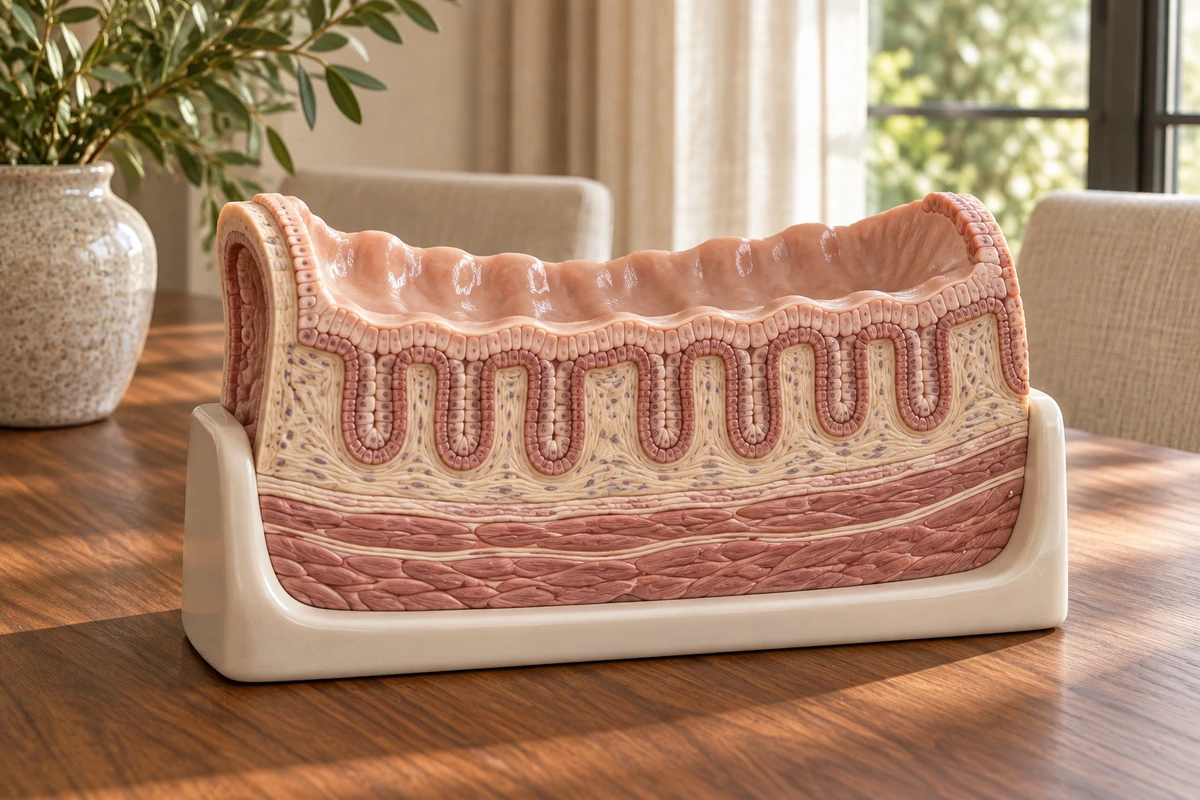
The Starting Point: Abnormal Gut Flora
Gut and Physiology Syndrome describes healthy gut flora as protecting and feeding the gut lining while supporting its constant renewal. When that microbial community is damaged, the book says toxins from pathogenic organisms can damage the junctions between intestinal cells and make the gut wall porous.[1]
The book’s ulcerative-colitis case begins with the child’s inherited microbial starting point and follows additional damage after repeated antibiotics in infancy.[3] It is one case history, so its sequence belongs to that child. The larger GAPS claim is that gut-flora damage and the condition of the gut wall matter across inflammatory bowel disease.
How the Gut Wall and Immune Response Connect
GAPS says that incompletely digested food, microbial products, and toxins can pass through a damaged intestinal wall and meet the immune system in forms that should not have entered the bloodstream. The source describes the resulting activity as chronic inflammation while the exposure continues.[2]
Campbell-McBride’s autoimmune model does not describe the immune system as attacking healthy tissue for no reason. It says microbes and toxins can alter or contaminate tissue, and the immune system responds to damaged material. In that framework, GAPS works upstream by changing the gut environment and supporting the intestinal barrier.[2]
Current NIDDK-supported research also finds close, complex relationships among the gut microbiome, microbial metabolites, immune activity, and inflammatory bowel disease. The research does not reduce Crohn’s disease or ulcerative colitis to one organism, and it continues to study how the microbiome changes during flares and remission.[4] That supports treating the microbial environment as a serious part of the picture without pretending one test identifies the whole cause.
Related Conditions and Complications
The official GAPS FAQ discusses primary sclerosing cholangitis, a disease of the bile ducts, in connection with ulcerative colitis and places both inside its gut-and-autoimmunity framework.[5] NIDDK likewise identifies inflammatory bowel disease, most commonly ulcerative colitis, as a common association with primary sclerosing cholangitis.[6] The association does not mean that every person with ulcerative colitis has PSC.
The GAPS FAQ explains anal fistulas as commonly beginning with an abscess in the rectal area and discusses abnormal flora in that context.[7] Separately, NIDDK defines an anorectal fistula as an abnormal tunnel from the anus or rectum to the surrounding skin and lists Crohn’s disease among the conditions that can cause one.[8] That is complication context, not a way to diagnose Crohn’s disease from one symptom.
The Gut Nervous System and Opiate-Like Peptides
In an official FAQ answer about low-dose naltrexone research, Campbell-McBride describes the gut’s extensive nervous system, sometimes called the second brain. She says incompletely digested proteins can form opiate-like peptides that bind to receptors in that nervous system and take part in the source-described autoimmune process at the gut wall.[9]
The cited study was short. The FAQ itself raises the unanswered question of what happens to those peptides after their receptors are blocked. GAPS therefore focuses on digestion and the gut environment that produced the peptide fragments rather than presenting receptor blockade as the whole answer.[9]
Probiotics in the GAPS Discussion
Gut and Physiology Syndrome lists inflammatory bowel disorders, including Crohn’s disease, ulcerative colitis, and chronic pouchitis, among the gastrointestinal conditions in which adding probiotics to treatment has improved or resolved the clinical picture.[10] Within GAPS, probiotics do not replace the diet. Fermented foods and probiotic preparations sit inside the larger plan to change the gut environment, and the protocol introduces them according to tolerance and the route being followed.
The GAPS Answer About Inflammatory Foods
Asked whether foods that stimulate inflammatory compounds such as TNF could worsen Crohn’s disease or ulcerative colitis, Campbell-McBride does not create a separate TNF food blacklist. Her answer is that the GAPS Nutritional Protocol is intended to be anti-inflammatory as a whole by changing the gut environment and the source-described immune activity.[11]
The practical food rules still matter. Use the Crohn’s and ulcerative colitis food guide when you need to translate this mechanism into the No-Plant, Intro, liquid-fast, meat-stock, and reintroduction branches.
Why the Mechanism Changes the Starting Route
When diarrhea, blood, mucus, pain, or an inability to tolerate early Intro foods shows a severely inflamed gut, GAPS may begin with No-Plant rather than the standard Introduction Diet. The source moves toward Intro after stools and inflammatory markers improve.[12] The mechanism and the route are connected: the more limited starting point is meant for a gut that cannot yet manage the wider early-stage foods.
Where to Go Next
- Return to the complete Crohn’s disease, ulcerative colitis, and GAPS guide for the diagnosis comparison, source history, medication overview, and recovery account.
- Use the food and protocol guide for the exact GAPS starting branches and food sequence.
- Use the symptoms and gut-signs guide to organize digestive and whole-body patterns without treating a checklist as a diagnosis.
If you want a guided introduction to the wider GAPS approach, my Understanding & Preparing for the GAPS Diet course is in the WFLI shop catalog.
Frequently Asked Questions
Does GAPS Blame One Microbe for IBD?
No. The GAPS model describes a damaged microbial ecosystem, a compromised gut wall, and ongoing immune activity. NIDDK-supported research also describes the microbiome relationship as complex and changeable across flares and remission.[4]
Are Probiotics the Whole GAPS Treatment?
No. The cited GAPS discussion places probiotics inside a broader nutritional protocol. The diet, digestive support, fermented foods, and stage or branch being followed all remain part of the route.[10]
Does a Fistula Prove Crohn’s Disease?
No. Crohn’s disease can cause fistulas, but fistulas have other causes and require their own diagnostic workup.[8]
References
- Campbell-McBride, N. Gut and Physiology Syndrome (2020), “Gut flora and the gut wall,” p. 56.
- Campbell-McBride, N. Gut and Physiology Syndrome (2020), “All autoimmunity is born in the gut,” pp. 55–58.
- Campbell-McBride, N. Gut and Physiology Syndrome (2020), ulcerative-colitis case study, p. 197.
- National Institute of Diabetes and Digestive and Kidney Diseases. “Close Ties Between the Microbiome and Inflammatory Bowel Disease.” Accessed October 7, 2026.
- Campbell-McBride, N. “Primary sclerosing cholangitis,” Q79, GAPS FAQs.
- National Institute of Diabetes and Digestive and Kidney Diseases. “Definition and Facts for Primary Sclerosing Cholangitis.” Accessed October 7, 2026.
- Campbell-McBride, N. “Anal fistula,” Q80, GAPS FAQs.
- National Institute of Diabetes and Digestive and Kidney Diseases. “Colonic and Anorectal Fistulas.” Accessed October 7, 2026.
- Campbell-McBride, N. “Low-dose naltrexone and the second brain,” Q2, GAPS FAQs.
- Campbell-McBride, N. Gut and Physiology Syndrome (2020), “Probiotics,” pp. 306–307.
- Campbell-McBride, N. “Inflammatory foods and TNF,” Q5, GAPS FAQs.
- Campbell-McBride, N. Gut and Physiology Syndrome (2020), “No-Plant GAPS Diet” and “Diarrhoea,” pp. 192–199, 369–370.

Leave a comment