

Bile helps your body handle dietary fat. The liver produces it, the gallbladder stores it, and the bile ducts carry it into the small intestine. Pancreatic enzymes work alongside it. Those are different jobs, and the distinction matters when a fatty meal leaves you feeling unwell.[1][3]
The GAPS books discuss fat tolerance, gradual introduction, and eating without a gallbladder. You can use those passages to understand the approach without assuming that nausea proves a particular bile problem.
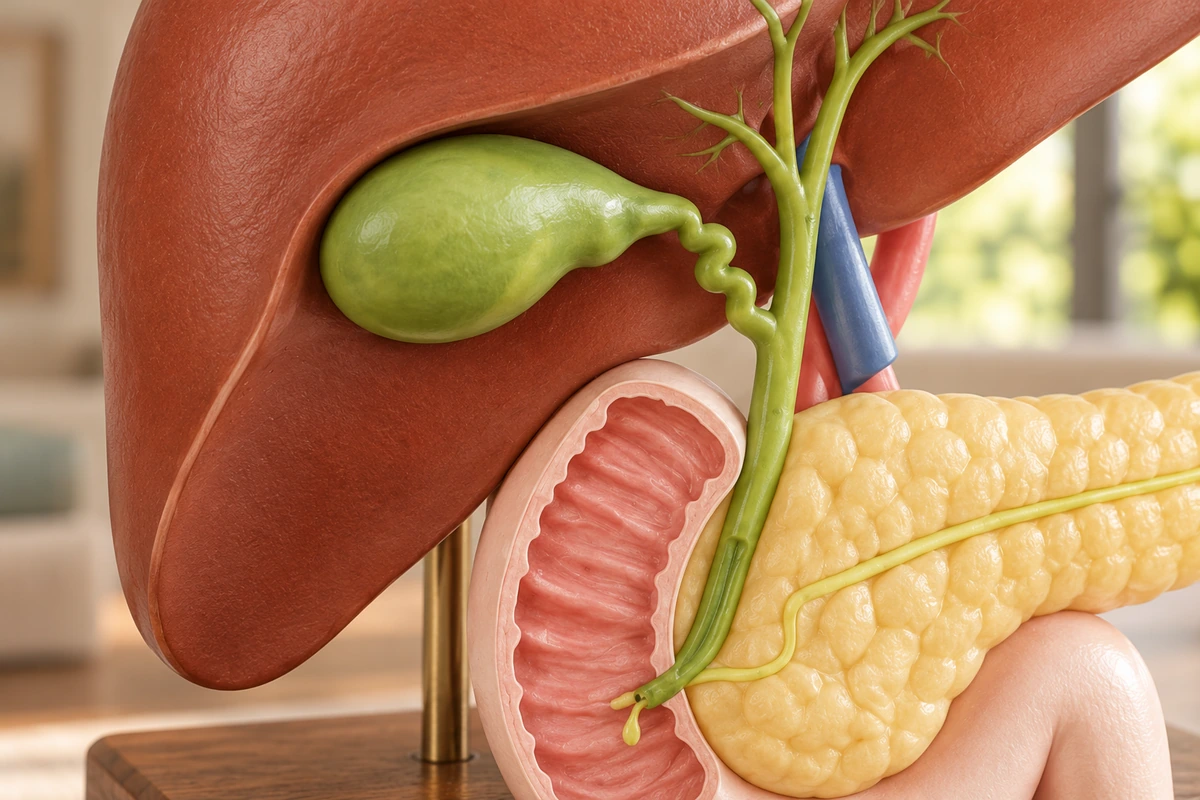
Bile and Enzymes Work Together
Bile helps disperse fat so digestion and absorption can take place. Pancreatic enzymes help break food down. Trouble with either part can affect fat digestion; greasy or pale stool is information to discuss, not a test that identifies the cause on its own.[3][5]
| Part | Main Role |
|---|---|
| Liver | Produces bile. |
| Gallbladder | Stores bile and releases it when needed. |
| Bile ducts | Carry bile to the small intestine. |
| Pancreas | Supplies digestive enzymes and bicarbonate. |
Why GAPS Emphasizes Fat Tolerance
Campbell-McBride describes people who feel bilious, nauseous, or unwell after fatty food and begin avoiding fat. She connects poor fat digestion with problems obtaining fat-soluble vitamins A, D, E, and K and essential fatty acids. Her approach is to introduce natural fats gradually according to tolerance.[1]
The useful instruction here is gradual introduction. The book does not supply a universal spoonful, a fixed week-long holding period, or proof that everyone who feels sick after fat needs more of it. Persistent symptoms still need their cause assessed.
What Stimulates Bile Release
Meal fat can help the gallbladder contract and empty. This supports the practical role of dietary fat in the meal response. It is different from saying that the liver becomes a pump that safely flushes every stone through a duct.[4]
The 2020 book describes liver-capsule contraction and relaxation of the ducts as part of its account. Campbell-McBride gives that explanation in the chapter. A fatty meal should not be used to provoke or diagnose suspected duct obstruction.[1]
After Gallbladder Removal
The liver continues producing bile after the gallbladder is removed. Bile then flows through the ducts into the intestine instead of being stored in the gallbladder. The liver does not acquire a new storage reservoir.[3]
In Liver Question 6, Campbell-McBride recommends gradual fats and temporary ox bile while fat tolerance improves. She reports people adapting to life without the gallbladder. The FAQ does not provide a success rate, guarantee that a supplement will become unnecessary, or an individual dose for every reader.[2]
Nausea and the Two Different FAQ Questions
Liver Question 4 discusses nausea after fat and recommends ox bile and gradual introduction. Gallbladder Question 4 is a different answer about a lingering taste of fat. It mentions cabbage juice, salad, and sauerkraut. Those answers should not be combined into one universal first-course instruction.[2]
If you use a preparation mentioned in the FAQ, it still has to fit your dietary stage and tolerance. Raw salad is not an Intro Stage 1 food, and a suggested food is not a diagnosis or a substitute for evaluating persistent symptoms.
Make the Meal Pattern Easier to Describe
- Record the actual food, preparation, and amount of fat, rather than writing only “a fatty meal.”
- Note when nausea, discomfort, or stool changes appeared.
- Keep medicines, supplements, and previous gallbladder surgery on the same page.
- Avoid changing several foods and supplements at once while trying to describe an ongoing pattern.
Our family started Intro together in July 2024 and moved through it over about three months. Everyone stayed on the same stage.[6]
When the Question Needs Prompt Attention
A suspected gallstone attack, persistent pain, fever, vomiting, jaundice, dark urine, or pale stools needs prompt assessment. Use the gallstone pain and urgent-care guide for that focused discussion rather than testing the problem with more fat.[7]
Your Next Step
Bring a clear meal-and-symptom record to your assessment. For the GAPS explanation of stones, continue with how gallstones form.
The 90-Day Family Food Diary is listed in the WFLI shop for families organizing food and symptom notes. You can also see the Family Kitchen Bundle there for the broader kitchen routine.
For the wider organ map and the other guides in this series, return to Liver, Bile, and Lungs.
References
- Campbell-McBride, Natasha. Gut and Physiology Syndrome (2020), “The Liver and the Lungs.”
- Campbell-McBride, Natasha. Official GAPS FAQs, “Liver,” Questions 4 and 6; “Gallbladder,” Question 4.
- NIDDK. Treatment for Gallstones.
- NIDDK. Eating, Diet, & Nutrition for Gallstones.
- NIDDK. Symptoms & Causes of Exocrine Pancreatic Insufficiency.
- Garnica, E. Personal account of whole-family Intro, supplied September 2026. Additional family chronology: Our GAPS Journey.
- NIDDK. Symptoms & Causes of Gallstones.

Leave a comment