

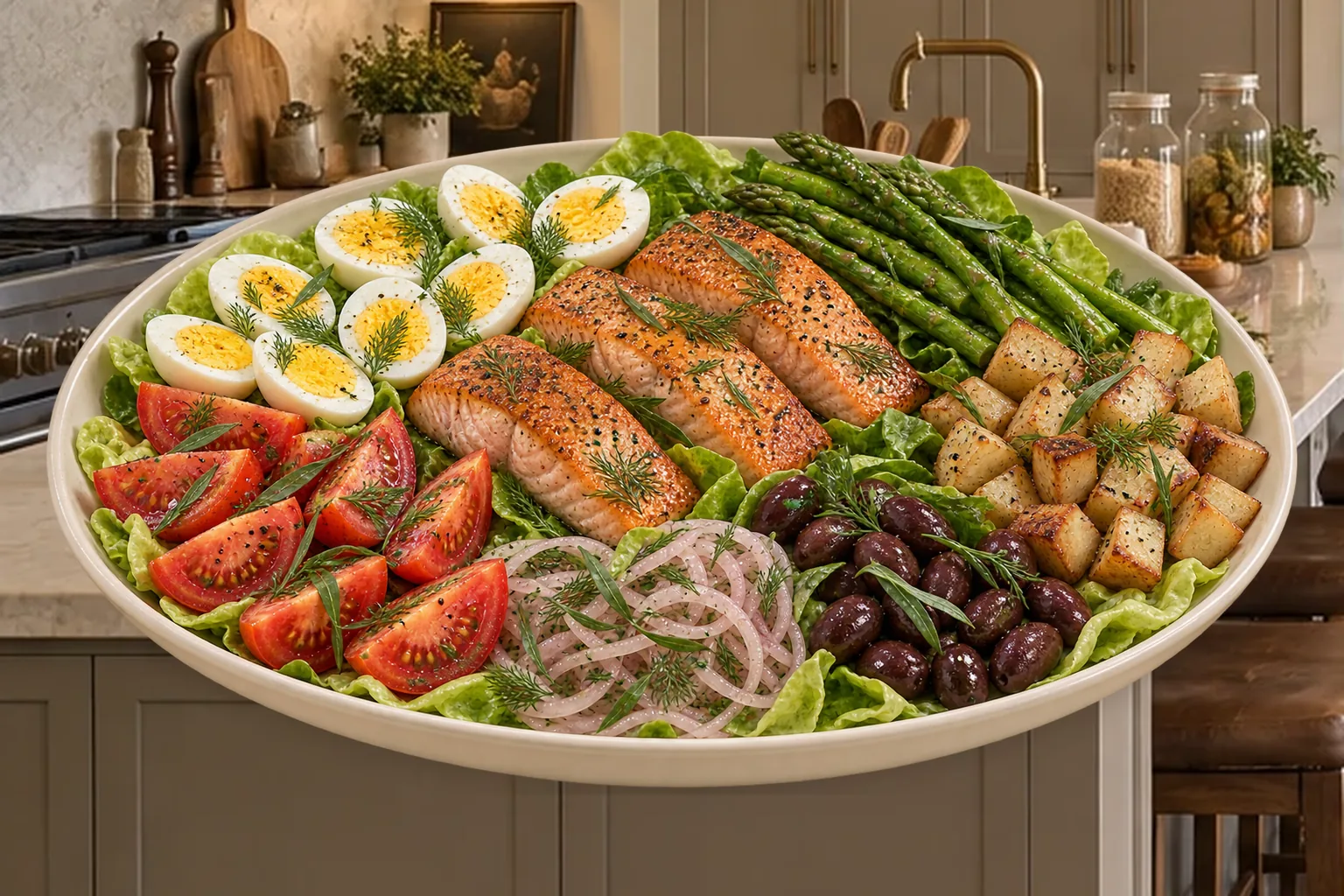
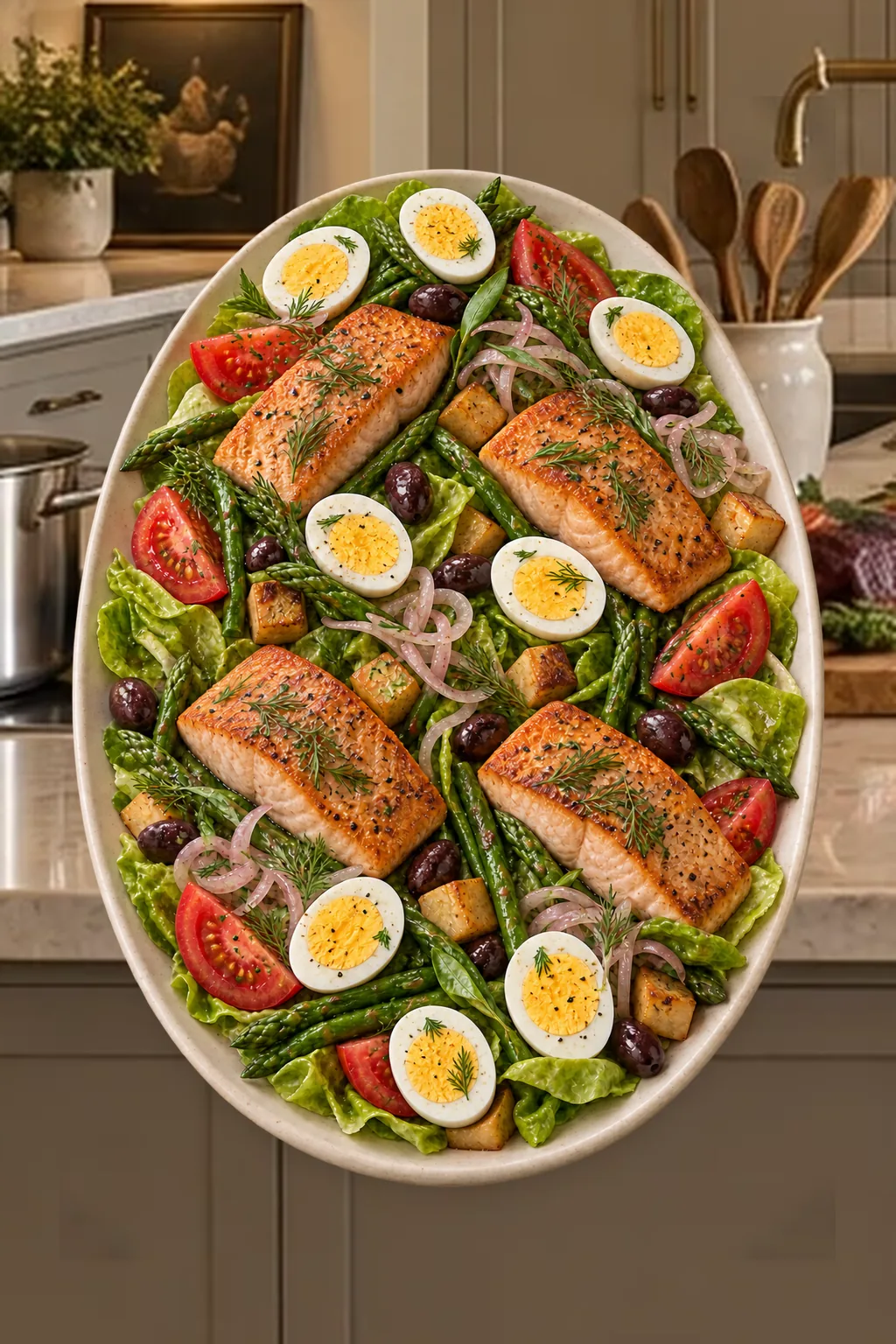
This Salade Niçoise salmon platter is a Full GAPS composed salad built from foods you can recognize across the platter. Crisp butter lettuce holds golden salmon, hard-boiled eggs, blanched asparagus, roasted roots, dill-marinated sweet onions, ripe tomato, dark olives, fresh herbs, and a light Fresh Herb Vinaigrette.
The finished platter looks generous because it is. It feeds four people as a complete meal, and every section brings a different texture. You get warm flaky salmon, firm egg whites, creamy set yolks, tender-crisp asparagus, browned root vegetables, cool lettuce, juicy tomato, and the sharp little lift of marinated onion.
In our family of eight, I need meals that let me do the thinking earlier in the day. I homeschool before work and leave for second shift, so four pans demanding attention at the same time is absolutely not the plan. This salad takes several components, but once those parts are ready, the last job is arranging them on one platter and carrying it to the table.
Where This Salade Niçoise Fits On GAPS
This complete version fits Full GAPS. It uses fresh salmon, eggs, butter lettuce, asparagus, allowed root vegetables, tomato, olives preserved without sugar or other non-allowed ingredients, fresh herbs, and a vinaigrette made with raw cold-pressed olive oil.
This is not an Introduction Diet recipe. It combines several foods and preparations on one plate, including a raw salad base and roasted vegetables. Use it once those individual foods and the linked component recipes already fit the way your household is following Full GAPS.
The olives deserve a quick label check. Choose plain olives preserved in brine, salt, oil, or another preparation that does not add sugar or ingredients outside your GAPS route. The dark olives in this version give a salty bite that balances the rich salmon and eggs.
Make The Components Before You Assemble The Platter
The easiest way to make this meal is to treat each prepared food as its own small job. The salad itself does not ask you to recook any of them. It asks you to arrange them while they still taste and look like themselves.
- Cook one batch of Pan-Seared Salmon for Full GAPS.
- Prepare one batch of Blanched Asparagus for Full GAPS.
- Prepare one batch of Dill-Marinated Sweet Onions for Full GAPS.
- Roast one batch of Roasted Root Vegetable Salad for Full GAPS.
- Mix one batch of Fresh Herb Vinaigrette for Full GAPS.
- Hard-boil four eggs, cool them, peel them, and cut each egg in half.
The onions improve after at least 20 minutes in their marinade, so start them early. The roasted roots can be served hot, warm, or at room temperature. The asparagus can be blanched and cooled before the salmon goes into the pan. That leaves the fish as the only component that benefits from your attention near serving time.
Keep every complete component in its own recipe and its own container until assembly. That protects the texture and keeps this post from turning into several recipes hidden inside one card.
Choose And Dry The Butter Lettuce
Use one large head or two small heads of butter lettuce. The leaves should feel tender but crisp, without slimy edges or dark wet spots. Separate the leaves, wash them well, and dry them completely.
A salad spinner makes this fast. Clean kitchen towels also work. Spread the washed leaves in one layer and blot them gently rather than crushing them. Water left on the lettuce thins the vinaigrette and makes the platter look slick instead of fresh.
Tear very large leaves into easy serving pieces. Leave smaller inner leaves whole. You want a loose bed of lettuce that can hold the heavier foods without turning into a packed mound.
Arrange The Vegetables In Clear Sections
Lay the lettuce across a low oval platter. Bring it close to the rim so green leaves remain visible around the finished salad. The lettuce is the base, but it should not be piled so high that the salmon slides.
Place the dill-marinated sweet onions near the center. Let excess marinade drip back into their bowl first. The onions should look glossy and relaxed, not submerged in liquid.
Add the blanched asparagus, roasted root vegetables, tomato wedges, and olives in separate sections. Keep the asparagus spears aligned so they are easy to lift. Keep the browned root cubes together so their crisp edges are not softened by tomato juice.
Cut one vine-ripened tomato into eight wedges. A ripe tomato should smell fresh at the stem and give slightly under gentle pressure. It should still be firm enough to hold a clean wedge on the platter.
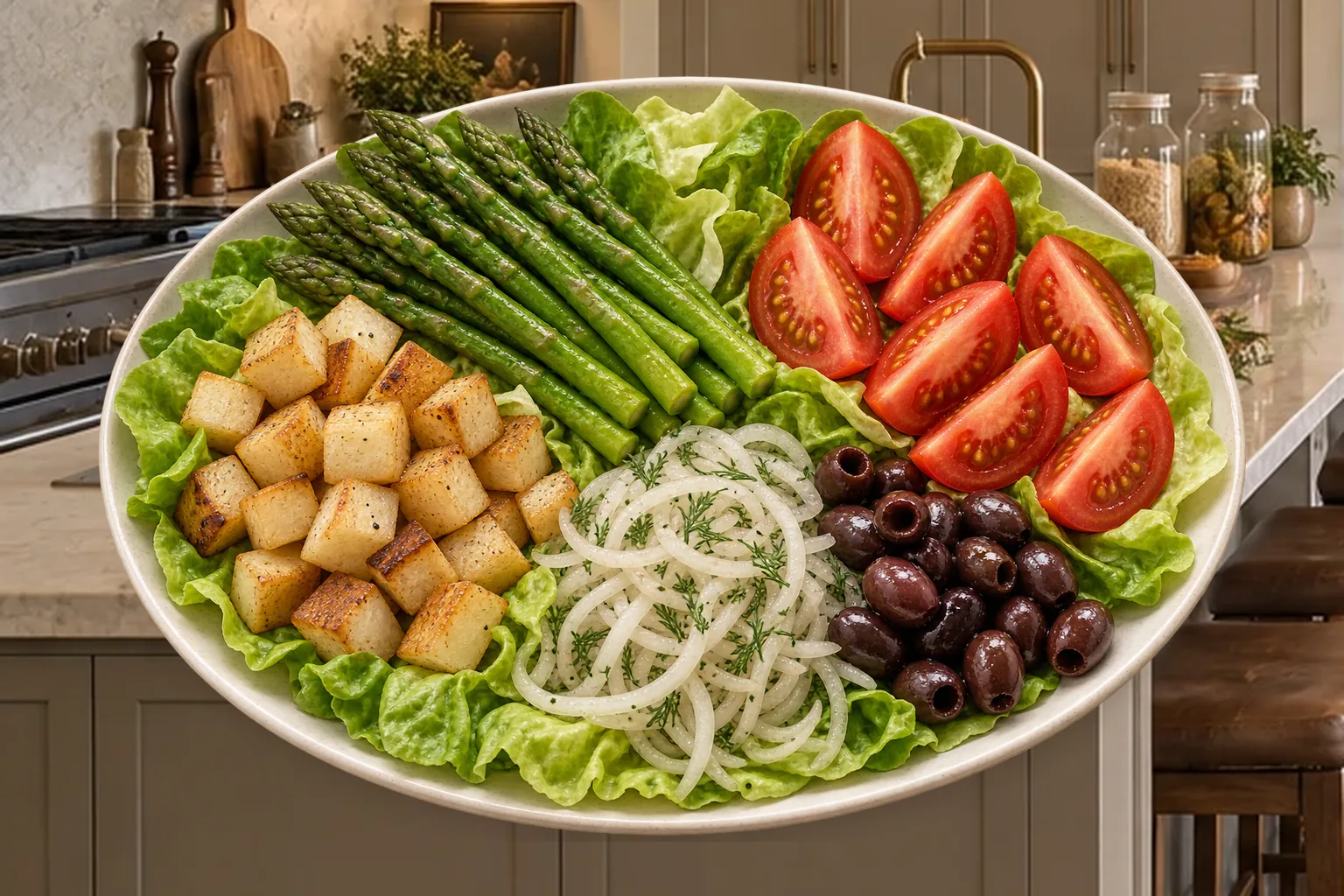
Pause here and look at the platter. You should still be able to identify every component immediately. If one section has swallowed the lettuce or spilled across the others, give it a little more room before adding the salmon and eggs.
Add The Salmon And Hard-Boiled Eggs
Place the four seared salmon portions around the platter so each serving is easy to reach. Their top surfaces should be golden, the sides should be moist coral, and the flakes should separate under gentle pressure. Do not break the salmon into loose pieces before serving. Whole portions keep the platter orderly and make the yield clear.
Add the eight hard-boiled egg halves between the other sections. Keep the yolks facing up. The whites should be firm and intact, and the yolks should be fully set rather than liquid in the center.
Use all four eggs. A finished photograph can make the platter look abundant, but the card still needs to match what is visible. Four eggs means eight halves, and four salmon portions means one clear portion for each serving.

At this point, the salad should look complete even before the herbs and vinaigrette. The salmon and eggs should sit securely on the lettuce without covering the asparagus, onions, roots, tomato, or olives.
Finish With Herbs And Vinaigrette
Tuck several small sprigs of fresh dill and tarragon around the platter. Use enough to bring their fresh aroma to the salad, but do not bury the salmon or eggs under a mat of herbs.
Drizzle a little Fresh Herb Vinaigrette over the assembled salad just before serving. The lettuce should pick up a light sheen. You should not see dressing pooled at the bottom of the platter.
Serve the remaining vinaigrette on the side. Some people will want extra on the roasted roots or salmon, while others will prefer the marinated onions and olives to provide most of the sharpness.
Freshly ground black pepper is optional. Add it at the table if it fits your household. The salad already has salt from several components, so taste the finished bite before adding more.
Use The Physical Cues
This is an assembly recipe, so the useful cues are about texture, temperature, and moisture. The lettuce should be dry and crisp. The asparagus should bend without collapsing. The roasted roots should hold their cubes and show browned faces. The onion strands should be softened and lightly glossy.
The salmon should have a browned surface and moist interior. The eggs should be cool enough to cut neatly, with firm whites and set yolks. Tomato wedges should hold their shape instead of leaving a puddle of juice across the lettuce.
When the vinaigrette goes on, the herbs should smell brighter and the platter should look lightly polished. If the lettuce begins to flatten or liquid gathers underneath, too much dressing was added too early.
Supported Swaps For This Full GAPS Salad
You can replace the asparagus with one batch of Blanched Green Beans for Full GAPS. Keep the same role on the platter: one green vegetable, blanched until tender but still intact, cooled, and arranged in its own section.
You can also replace the sweet onions with one batch of Dill-Marinated Cucumber for Full GAPS. Use the onions or the cucumber as the marinated component. Do not pile both onto the platter and quietly change the formula.
This post keeps seared salmon as the measured protein. That makes the title, photographs, recipe card, and instructions agree. Other fish preparations belong in their own clearly measured versions rather than inside a list of vague choices.
Serve The Salad As One Complete Meal
Set the platter in the center of the table with a broad serving spoon or salad servers. Each plate should get lettuce, salmon, half of an egg or more, asparagus, roots, onion, tomato, and olives. Pass the extra vinaigrette separately.
The composed layout helps when people like different parts of a meal. Nothing is hidden in a creamy mixture, and no one has to guess what is under the lettuce. Each person can take a little more asparagus or leave extra onion for someone else without changing the recipe for the whole table.
If you prepare parts earlier in the day, keep the chilled components separate and assemble close to serving. Do not dress the lettuce in advance. The finished salad is best while the leaves are crisp and the salmon still has the texture you worked for.
Recommended Equipment
- Large low oval serving platter
- Salad spinner or clean kitchen towels
- Sharp chef’s knife
- Stable cutting board
- Small bowls for prepared components
- Serving spoon or salad servers
Frequently Asked Questions
Is This An Introduction Diet Recipe?
No. This is a Full GAPS composed salad. It combines raw lettuce and tomato with several separately prepared foods.
Can I Use Green Beans Instead Of Asparagus?
Yes. Use one batch of the linked blanched green beans in place of the asparagus. Keep the rest of the measured platter unchanged.
Can I Use Dill-Marinated Cucumber Instead Of Onion?
Yes. Use the linked dill-marinated cucumber as the one marinated component. Drain off excess marinade before it goes on the lettuce.
Why Are Potatoes Not Used?
This Full GAPS version uses roasted rutabaga, celery root, and black radish. The browned cubes fill the hearty root-vegetable role without adding potatoes.
How Do I Choose Olives?
Read the ingredient label and choose olives preserved without sugar or other non-allowed ingredients. Plain dark olives give the platter the intended salty contrast.
Can I Dress The Salad Ahead Of Time?
Wait until serving. Early dressing softens the lettuce and lets liquid collect under the components. Drizzle a little over the finished platter and serve the rest on the side.
Can I Serve Individual Plates Instead?
Yes. Divide the lettuce and each measured component evenly among four plates. Keep every plate composed in sections so the salmon, eggs, vegetables, and marinated onion remain easy to see.
How Do I Know The Platter Is Balanced?
You should see green lettuce around the rim and a clear section of every component. The salmon and eggs should be evenly distributed, and no dressing should pool underneath.
Salade Niçoise With Seared Salmon Recipe
Salade Niçoise With Seared Salmon for Full GAPS
Ingredients
Equipment
Method
- Wash and completely dry the butter lettuce. Tear large leaves into serving pieces and spread all of the lettuce across a large low oval platter, bringing some green leaves close to the rim.
- Drain excess marinade from the dill-marinated sweet onions and place them near the center of the platter.
- Arrange the blanched asparagus, roasted root vegetables, tomato wedges, and olives in separate sections over the lettuce. Keep the asparagus intact, the browned root cubes together, and the tomato away from the roots so its juice does not soften their edges.
- Arrange the four seared salmon portions and all eight hard-boiled egg halves evenly over the platter without covering the vegetable sections. Keep every yolk facing up.
- Tuck the fresh dill and/or tarragon around the platter. Add optional black pepper if it fits your household.
- Drizzle a little Fresh Herb Vinaigrette over the salad just before serving, stopping when the leaves have a light sheen without pooled dressing. Serve the remaining vinaigrette on the side and divide the platter among four people.
Notes
Primary route: Seared salmon, blanched asparagus, dill-marinated sweet onions, roasted rutabaga/celery root/black radish, hard-boiled eggs, tomato, allowed olives, fresh herbs, and Fresh Herb Vinaigrette.
Supported swaps: Use one batch of blanched green beans instead of asparagus, or one batch of dill-marinated cucumber instead of onions.
Physical cues: Keep the lettuce dry, vegetables in distinct sections, salmon broadly golden with a moist center, yolks fully set, and vinaigrette light enough that it does not pool.
Make-ahead: Prepare the separate components earlier the same day, keep chilled components separate, and dress the lettuce only at serving.
Tried this recipe?
Let us know how it was!Make The Busy Part Assembly
The planned Weekly Kitchen Rhythm Planner is designed for meals like this, where several simple components can be made in the right order instead of all at once. Find current resources and upcoming releases in the WFLI shop.

Leave a comment