

Gut and Psychology Syndrome describes a very specific feeding pattern in severe cases: a baby refuses the breast or falls asleep after only a few mouthfuls. Campbell-McBride gives two possible routes for that pattern. One involves opiate-like toxins produced by abnormal maternal gut flora. The other involves milk antigens crossing a damaged maternal gut wall and reaching breast milk.[1]
Those routes are easy to blur together, especially when a family is tired and trying to understand a difficult feed. This guide keeps them separate, shows what the newer GAPS book adds, and explains what research can support about food-derived milk proteins without turning every short feed into the same story.
The Exact Feeding Pattern in the Source
The passage concerns babies who refused the breast or fell asleep after the first few mouthfuls in severe cases of maternal dysbiosis, an unhealthy balance of gut microbes. Dr. Natasha describes that feeding pattern before giving the two possible explanations.[1]
Write down the pattern as it actually happens: whether the baby refuses immediately or begins feeding, how many mouthfuls occur, whether the same response happens at every feed, and which changes happened at the same time. That record is more useful than starting with a conclusion and trying to make every feed fit it.
Path One: Opiate-Like Microbial Toxins
Campbell-McBride says abnormal gut flora can produce many toxic substances that enter the mother’s blood and then her milk. In the severe cases described, she proposes that toxins with a chemical structure like opiates help explain why a baby falls asleep after a few mouthfuls.[1]
This is a microbial-toxin explanation in the GAPS framework. It is different from casomorphins and gluteomorphins created when casein and gluten are incompletely digested. The words opiate-like appear in both discussions, but the substances and how they are produced differ. Here, Dr. Natasha is discussing microbial toxins reaching breast milk.[1][6]
Path Two: Milk Antigens
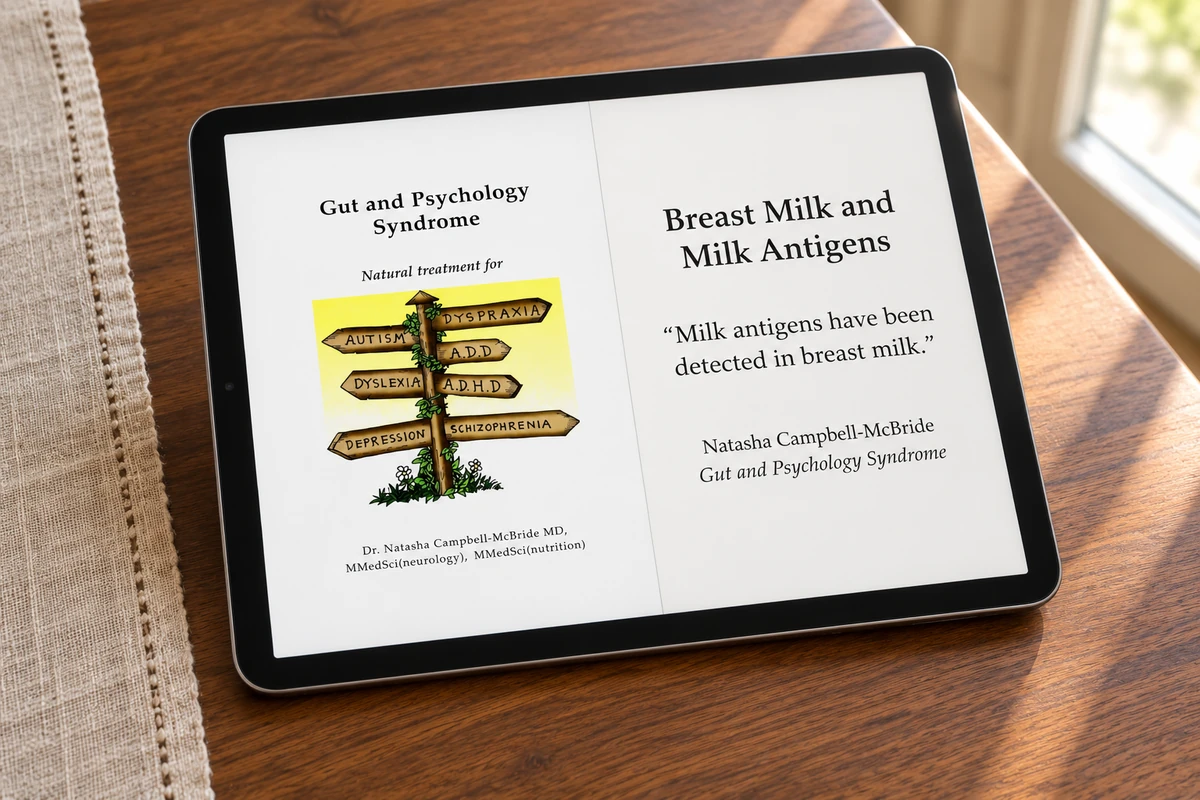
The second proposed route is milk allergy. Milk antigens are milk-protein substances recognized by the immune system. The earlier book says a damaged and permeable maternal gut wall can allow incompletely digested proteins and antigens into the blood. It then says milk antigens have been found in breast milk.[1]
Campbell-McBride reports cases in which a baby returned to the breast after the mother removed dairy from her own diet. She also says severe infant eczema may improve with that change. These are the book’s reported cases inside the milk-antigen route. They are not a universal instruction for every nursing mother to remove dairy.[1]
What Research Shows About Food-Derived Milk Proteins
A 1985 study tested milk from 38 mothers and detected immunoreactive bovine beta-lactoglobulin in 18 samples. Three mothers whose infants had colic had relatively high levels. During a cow’s-milk-free period, the measured amount fell to undetectable levels in two mothers and declined in the third; the three infants’ colic resolved during that observation.[3]
A 2016 mass-spectrometry study compared milk from 12 donors. It identified fragments from bovine beta-lactoglobulin in two of six samples and a casein fragment in one of six samples from mothers drinking cow’s milk; those fragments were absent from samples in the dairy-free group. The study detected peptide fragments rather than intact cow’s-milk protein.[4]
These studies support the narrower point that food-derived cow’s-milk proteins or peptides can appear in human milk. They did not test Campbell-McBride’s separate opiate-like microbial-toxin explanation. Keeping the evidence attached to the question it actually studied makes the two pathways easier to understand.[3][4]
The Protective Side of the Same Milk
The earlier book does not describe breast milk only as a route for unwanted substances. It says a mother also develops antibodies against pathogenic microbes in her gut and passes those antibodies through her milk. Campbell-McBride says they help keep abnormal flora in the baby under control while breastfeeding continues.[1]
The 2020 book adds living microbes, immune cells, immunoglobulins, enzymes, growth factors, hormones and neurotransmitters to the picture. It calls breast milk a probiotic food and says it supplies both microbes and the food that supports their growth.[2] The breast milk versus formula guide explains that broader comparison.
What the Current Book Adds
Gut and Physiology Syndrome says toxins circulating in a woman’s blood can finish up in her milk. It then describes severe situations in which the mother’s milk appears to make the baby ill and names type 1 diabetes, FPIES, severe allergies, severe eczema, severe digestive problems, epilepsy, and severe problems with mental and physical development among the cases in that discussion.[2]
When the mother cannot breastfeed in those situations, the current book directs the family to a healthy wet nurse rather than presenting formula as the preferred replacement.[2] She discusses that alternative for the severe cases alongside the protective benefits of breast milk.
Keep the Two Pathways Separate
| What the Source Describes | Proposed Route | What to Record |
|---|---|---|
| Breast refusal or sleep after a few mouthfuls in severe maternal-dysbiosis cases[1] | Opiate-like toxins produced by abnormal maternal gut flora | The exact feeding pattern, timing, repetition, and any simultaneous maternal or infant changes |
| Breast refusal or severe infant eczema in the book’s dairy-removal cases[1] | Milk antigens crossing a damaged maternal gut wall and reaching milk | Maternal dairy exposure, infant response, dates, and what changed when dairy was removed or returned |
| Abnormal flora controlled while breastfeeding continues[1] | Maternal antibodies | Feeding duration and what changed around weaning |
The breast-milk antibodies and weaning guide continues with the protective-antibody part of the source and what Campbell-McBride says changes when breastfeeding ends.
What This Looked Like in Our Family
I have nursed for almost six years straight.[5] Nursing has been part of everyday family life for a long stretch, alongside making meals for everyone else.
I ate what I cooked for our family. After our fifth baby, I moved from postpartum Intro to Full GAPS because Intro was too restrictive for postpartum and breastfeeding.[5] I share that postpartum transition in my nursing on GAPS story.
Prepare the Feeding Questions Before Birth
Baby Prep Week, my free email series, helps both parents organize their food, home, and feeding questions before the baby arrives. You can start with my pregnancy, birth, and breastfeeding preparation guide.
Frequently Asked Questions
Does the Book Say Every Sleepy Baby Is Receiving Opiate-Like Toxins?
No. The passage describes severe cases in which a baby refused the breast or fell asleep after the first few mouthfuls, then proposes the microbial-toxin route as an explanation for those cases.[1]
Are Opiate-Like Microbial Toxins the Same as Casomorphins?
Not in these passages. The breast-milk passage describes toxins produced by abnormal gut flora. Casomorphins are peptide products discussed in the separate casein-digestion pathway.[1][6]
Does Removing Dairy Always Resolve Breast Refusal or Eczema?
The book reports some cases in which a baby returned to the breast or severe eczema improved after maternal dairy removal. It presents those outcomes as examples within the milk-antigen route, not as a guaranteed result for every family.[1]
Have Cow’s-Milk Proteins Been Found in Human Milk?
Yes. The studies cited here detected bovine beta-lactoglobulin or cow’s-milk-derived peptide fragments in some human-milk samples. Detection varied by mother and study method.[3][4]
Does This Article Say Breast Milk Is Harmful?
No. The earlier book describes protective maternal antibodies passing through breast milk.[1] The 2020 book adds living microbes, immune cells, immunoglobulins, enzymes, growth factors, hormones, neurotransmitters, and other active components.[2] This guide explains the two severe-case pathways the books place inside that larger picture.
References
- Campbell-McBride, Natasha. Gut and Psychology Syndrome, expanded edition (2013), severe maternal dysbiosis, breast refusal, opiate-like microbial toxins, milk antigens, dairy-removal cases, and maternal-antibody passages. Consulted in the second German edition (2015), translated from the expanded English edition (2013).
- Campbell-McBride, Natasha. Gut and Physiology Syndrome (2020), breast-milk microbiome and severe maternal-to-infant milk-transfer discussion; “Wet nursing.”
- Jakobsson, I., et al. “Dietary Bovine Beta-Lactoglobulin Is Transferred to Human Milk.” Acta Paediatrica Scandinavica (1985). PubMed 4003058.
- Picariello, G., et al. “Antibody-Independent Identification of Bovine Milk-Derived Peptides in Breast-Milk.” Food & Function (2016). PubMed 27396729.
- Garnica, Ebonie. Nursing on GAPS family story.
- Campbell-McBride, Natasha. Gut and Physiology Syndrome (2020), “Proteins.”

Leave a comment