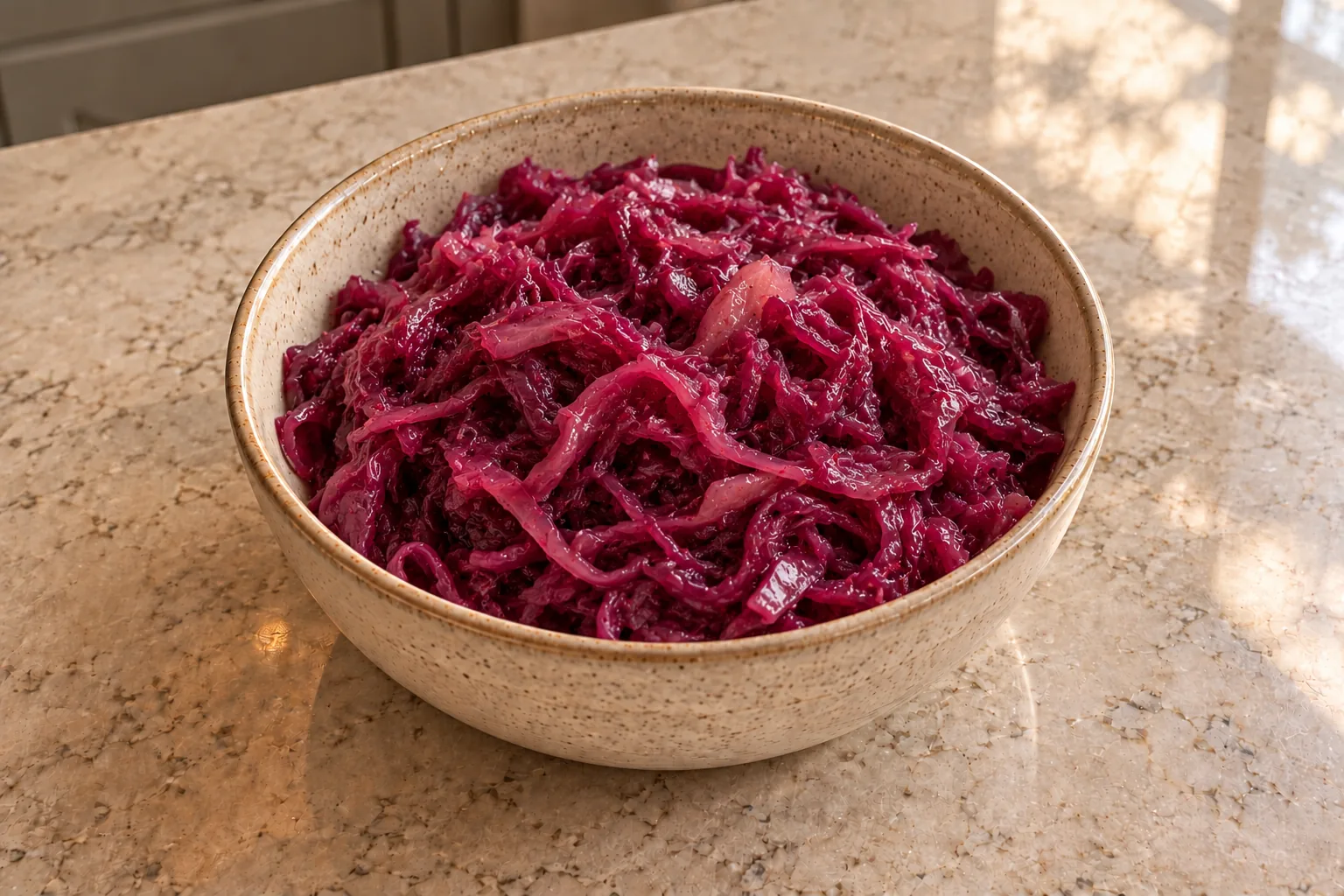
Ingredients
Equipment
Method
- Clean the jars and tools. Remove damaged outer cabbage leaves, reserving two clean leaves for covering. Cut out the hard core and slice the remaining cabbage into thin strips.
- Divide the cabbage evenly between two wide-mouth quart glass jars. Divide the measured salt evenly between them. Cover and shake to distribute it.
- Leave for one hour so the cabbage wilts and begins releasing purple juice. The shreds should look less springy and start settling in the jars.
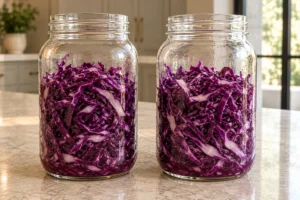
- Uncover and press firmly to compact the cabbage, remove large air pockets and raise the liquid. Fold a reserved cabbage leaf over each jar and add a glass fermentation weight. Keep all cabbage below liquid, with about two inches of empty headspace. If needed after pressing, add just enough filtered water for submersion.
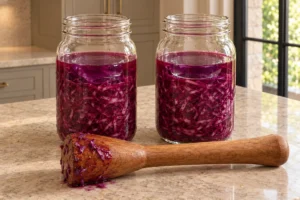
- Fit fermentation lids and stand the jars in a tray at room temperature out of direct sunlight. With ordinary screw lids, briefly loosen daily during the first few days to release pressure, then close again; continue checking as activity slows. With an airlock, follow its instructions. Keep the cabbage submerged.
- Allow roughly one week to one month, depending on temperature. For GAPS, finish when the cabbage has a sharp acidic taste and no more gas is coming from it. Do not use three days as automatic completion.
- Refrigerate the completed kraut covered with its brine. Use a clean utensil to serve and keep the remaining cabbage submerged.
Notes
Time: About 20 minutes hands-on preparation, a one-hour wilt, then roughly one week to one month of fermentation. Total elapsed time varies; sharp acidity and stopped gas determine completion.
Yield: One batch. The source estimates about two quarts, but cabbage size, packing and headspace change the actual yield. Jar capacity is not a guaranteed finished volume.
GAPS: Solids begin gradually at Intro Stage 3, continuing through later Intro and Full GAPS. Earlier Intro uses only juice from the completed ferment. Add fermented juice to stock or soup after it is no longer very hot.
Scaling: At 2× use two heads and four tablespoons salt, with enough additional jars for the same headspace. Fermentation time does not double. Green cabbage is an alternative in this same method.
Storage: Refrigerate the completed kraut covered with its brine. Serve with a clean utensil and keep the remaining cabbage submerged.