Go Back
–+ servings
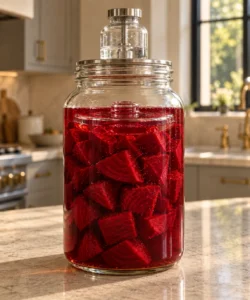
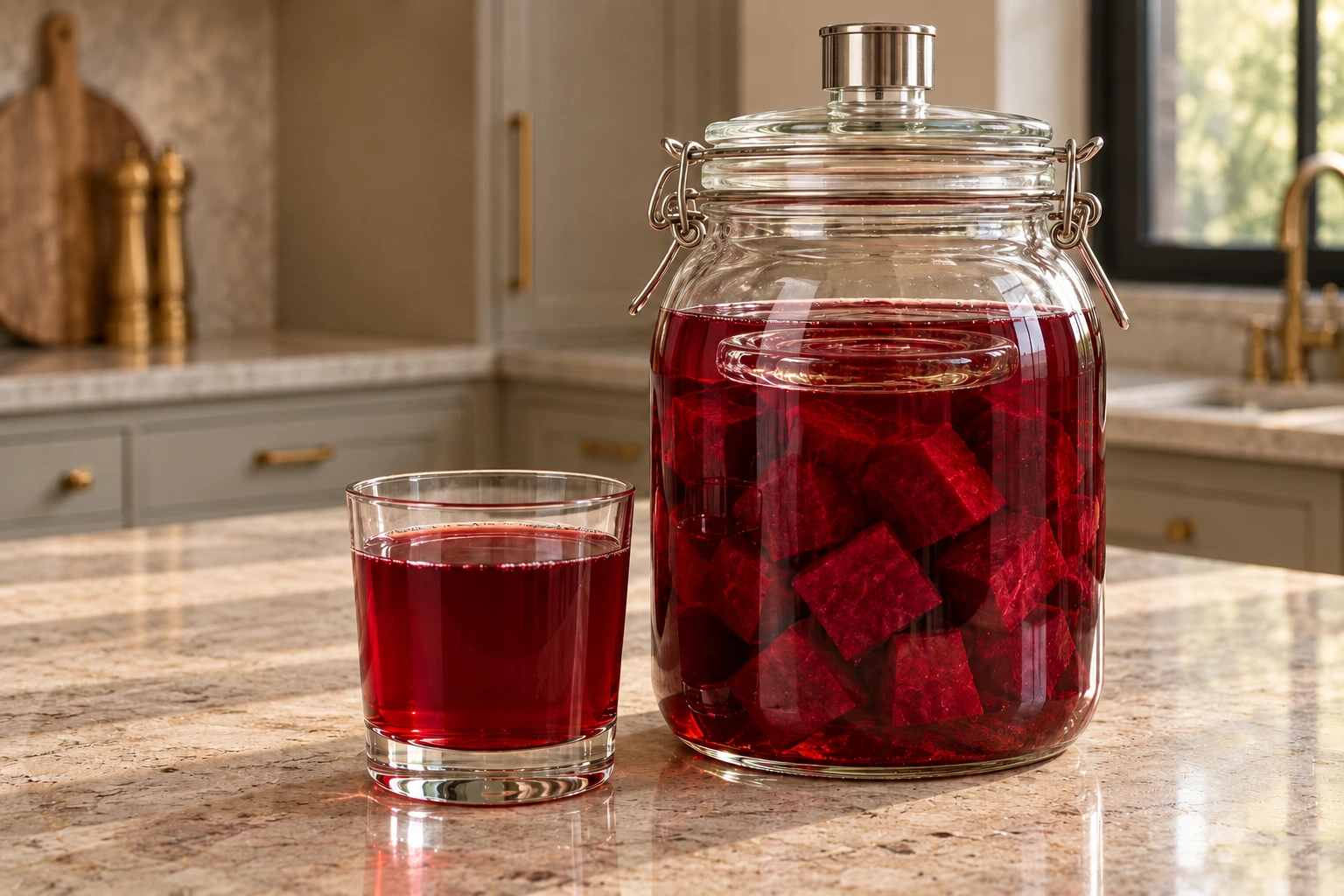
Plain no-whey beet kvass in a clear glass beside a two-quart fermentation jar

Plain Beet Kvass Without Whey for Full GAPS

A plain no-whey beet kvass made with three medium beets, mineral salt, filtered water, full submersion, and a pressure-aware closure.
Prep Time 5 minutes
Servings: 8 cups
Course: Beverage
Cuisine: Eastern European-Inspired, GAPS

Ingredients
  

  • 3 medium red beets cut into roughly 1-inch chunks
  • 2 tablespoons mineral salt
  • filtered water enough to fill the selected vessel while leaving about 2 inches headspace

Equipment

  • Wide-mouth glass fermentation vessel sized to the batch
  • Glass, ceramic, or uncoated stainless fermentation weight
  • Pressure-aware airlock or self-venting closure
  • Stainless-steel knife and stable cutting board
  • Fine uncoated stainless-steel strainer and wide glass bowl
  • Clean glass refrigerator jar

Method
 

  1. Place the roughly 1-inch beet chunks in a clean wide-mouth glass fermentation vessel sized to the batch.
  2. Add the mineral salt, then add filtered water while leaving about 2 inches of headspace. Disperse the salt without adding whey or another starter.
  3. Set a clean glass, ceramic, or uncoated stainless fermentation weight over the beets so every solid remains below the liquid.
  4. Fit an airlock or another self-venting, pressure-aware closure. Ferment at room temperature out of direct sunlight.
    One-inch beet chunks fully submerged under a glass weight in plain beet kvass
  5. Begin checking around day 4 or 5. Continue until the liquid is deep ruby and tastes pleasantly tart. Use flavor as the endpoint rather than a taut lid, stopped gas, or routine burping.
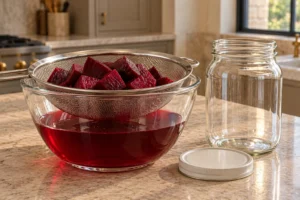
  6. Remove the weight, strain through a fine stainless-steel strainer securely nested over a glass bowl, transfer to a clean glass jar, cover, and refrigerate.
    Fermented beet chunks draining in a stainless strainer over strained ruby kvass

Notes

  • Full GAPS: Use once plain beet kvass is introduced and tolerated.
  • Intro Stage 1: Use only strained fermented liquid, beginning gradually with 1 to 2 teaspoons.
  • Fermentation time: Begin checking around day 4 or 5 and continue until pleasantly tart. Fermentation time is not cook time.
  • Storage: Keep covered and refrigerated. The source does not provide a verified duration.
  • Yield: This recipe makes about two quarts (eight cups). A doubled batch makes about four quarts (sixteen cups).
  • Scaling: Use a vessel large enough for the scaled solids, liquid, weight, and headspace. Do not crowd a 2x batch into one two-quart jar.

Tried this recipe?

Let us know how it was!