
Ingredients
Equipment
Method
- Clean the mixing bowl, utensils, jars, and fermentation weights. Reserve clean whole cabbage leaves for covering the jars. Remove the hard core and shred the remaining cabbage into small pieces.
- Grate the carrots and the ginger knob. Mince the garlic. Weigh the combined prepared cabbage, carrots, ginger, and garlic, excluding the reserved cover leaves.
- Multiply the vegetable weight in grams by 0.02 for the salt weight. For example, 1,000 grams vegetables needs 20 grams salt. Weigh that amount of natural mineral sea salt.
- Mix the prepared vegetables with the weighed salt. Massage and squeeze with clean hands, turning the mixture, until the shreds are flexible and wet and juice collects in the bowl. A squeezed handful should release juice.

- Stir in the caraway seeds. Pack into clean wide-mouth glass jars in layers, pressing firmly to close large air pockets. Divide the released juice among the jars.
- Fold reserved cabbage leaves over the shreds and add fitting glass weights. Keep the vegetables, leaves, and weights submerged beneath brine, with about two inches of headspace. If more brine is needed, dissolve 1½ tablespoons sea salt in 1 quart boiling filtered water, cool completely, and add only enough to maintain submersion.
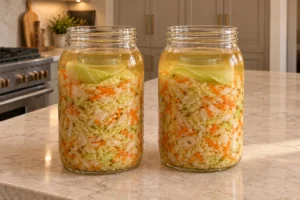
- Fit pressure-releasing fermentation lids or loosely fitted standard canning lids that allow gas to escape. Follow the lid setup directions. Keep around 65–75°F out of direct sunlight; do not seal active fermentation without pressure release.
- Check after about two days, then every two or three days while active. Keep the vegetables submerged and press down with clean utensils as needed. Use cooled covering brine only if necessary.
- Around two weeks, check taste and activity. GAPS readiness is sharply acidic taste and no more gas coming from the kraut, generally one week to one month depending on temperature. Refrigerate completed kraut with its brine and use clean utensils when serving.
Notes
Salt: Weigh the combined prepared vegetables and multiply by 0.02. The salt concentration remains 2% at every batch size. The optional brine uses its own tablespoon measure; do not substitute it for the weighed salt mixed into the vegetables.
Yield: About 32 small servings; the finished volume varies with the size of the vegetables. Have enough jars for the actual batch and preserve two inches of headspace.
Time: Prep estimate 30 minutes. Fourteen days is a fermentation estimate, not an automatic completion date. For GAPS use sharp acidic taste and stopped gas production, generally one week to one month.
GAPS: This seasoned kraut fits Full GAPS. Use plain green sauerkraut for an earlier Intro preparation. Vegetable solids begin gradually at Intro Stage 3; completed-ferment juice is introduced earlier.
Storage: Refrigerate completed kraut with its brine. Use clean utensils and keep the remaining vegetables submerged.