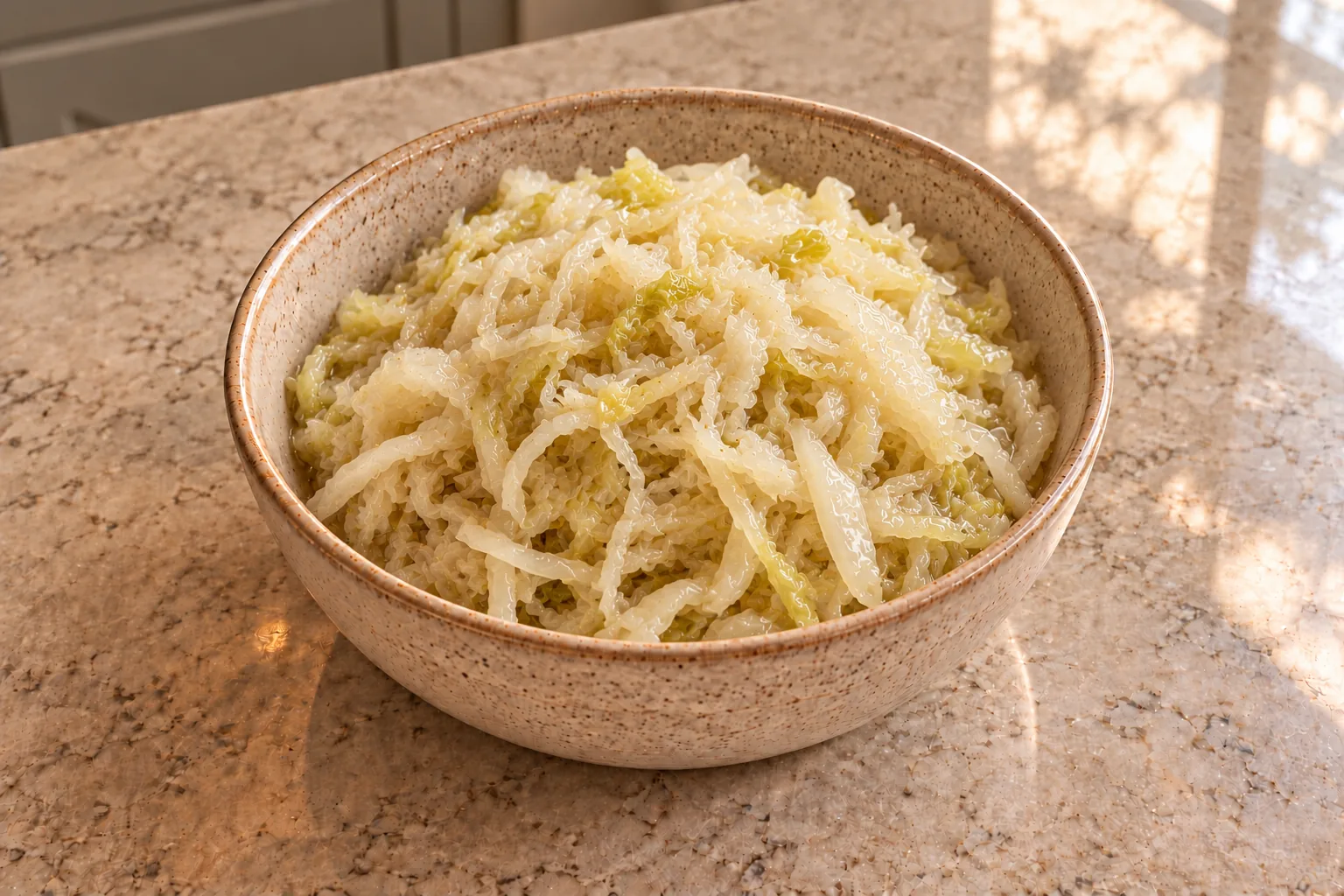
Ingredients
Equipment
Method
- Clean the jar, bowl and tools. Remove damaged outer cabbage leaves and reserve one clean whole leaf from the head. Wash the cabbage, remove the hard core, and shred the remaining leaves finely.
- Mix the shredded cabbage and mineral salt in a glass bowl. With clean hands, massage and squeeze for about 2–3 minutes until the shreds are wet and release juice when squeezed.
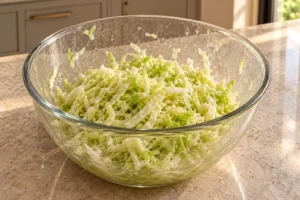
- Pack into a wide-mouth quart glass jar, pressing firmly to remove large air pockets. Add all the juice from the bowl. Place the reserved leaf over the shreds and keep the cabbage submerged with a weight if needed. Leave about two inches of headspace. Cover the jar with a clean dish towel and rest for at least four hours.
- Remove the towel and press down again until the cabbage and cover leaf are beneath liquid. Keep a fermentation weight in place if needed. Add a little filtered water only if pressing does not provide enough liquid to cover the vegetables. Keep the headspace clear.
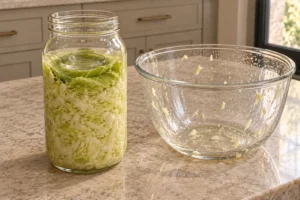
- Fit a pressure-releasing fermentation lid or ordinary screw lid. With a standard lid, briefly loosen daily during the first few days to release gas, then close again; continue checking as activity slows. Follow an airlock’s instructions if using one. Keep at room temperature out of direct sunlight and away from heat, with the cabbage submerged.
- For GAPS, allow roughly one week to one month, depending on temperature, until the cabbage tastes sharply acidic and is no longer producing gas. The four-hour rest is not the full fermentation. Refrigerate the completed kraut with its brine and use a clean utensil to serve.
Notes
Time: The four-hour rest happens after the cabbage is packed into the jar. Allow additional hands-on time, including about 2–3 minutes of kneading, then roughly one week to one month of fermentation. The displayed time is a minimum planning estimate, not a fixed completion time.
Yield and jars: One batch, approximately one quart. Cabbage size and trimming vary; use another jar if necessary rather than reducing the two-inch headspace.
GAPS: Earlier Intro uses only juice from the completed ferment. Solids begin gradually at Stage 3 and continue into later Intro and Full GAPS.
Scaling: At 2×, use two heads, three tablespoons salt, and two leaves reserved from those heads. The four-hour rest does not double. Use enough jars to keep the same headspace.
Storage: Refrigerate completed kraut with its brine. Use clean utensils and keep the remaining cabbage submerged.